Showing posts with label hazard mitigation. Show all posts

Thursday, June 3, 2010

Perception of volcanic hazards in Iceland

ResearchBlogging.orgThe eruption may be subsiding a bit, but there is still a lot of discussion (and arguing) centered around the Eyafyallajökull event. It's not entirely surprising; most people in Europe don't have to deal with active volcanoes, and the last time an Icelandic one caused widespread trouble was in the 18th century. But what about the Icelandic response? One might assume, given the prevalence of volcanic and geothermal activity in Iceland, not to mention hazards caused by volcano-water interaction, that Icelanders might be better prepared than other Europeans to deal with natural hazards. But is that really the case?

In "Resident perception of volcanic hazards and evacuation procedures", published in 2009 in Natural Hazards and Earth Systems Science, Australian and Icelandic scientists set out to evaluate how Icelanders perceived risk and what their response would be to an evacuation drill for a jökulhlaup hazard. The study was conducted in March 2006 in the jökulhlaup hazard zone of Rangávallasýsla, a region immediately adjacent to the Mýrdalsjökull and Eyafyallajökull glaciers and the Katla volcano, which is notorious for producing jökulhlaups.


Figure 1 from Bird et al. (2009). The jökulhlaup hazard zone of Rangávallasýsla. The hazard zone is the maximum area that a  catastrophic jökulhlaup is expected to flood. Evacuation centers are represented by blue triangles.

The authors of the study used a combination of methods to assess the reactions of residents and emergency officials: they directly observed an evacuation drill, did face-to-face interviews with officials and residents, and distributed surveys to those involved in the drill. The authors also discuss the parameters of the drill:

If an eruption is imminent residents would be notified via a text message to their mobile phone. If residents do not have a registered mobile phone number a recorded message would call through to their landline. Upon receiving this message residents have 30 minutes to prepare to evacuate. However, if an eruption occurs without precursory activity, residents will be instructed to evacuate immediately. Before leaving, they are required to hang the evacuation sign outside their house to indicate that they have left. Certain residents in each region have volunteered to ‘sweep’ their local area to ensure their neighbours have left for the evacuation centres...
To test the proposed evacuation plan the ICP conducted a full scale evacuation exercise on 26 March 2006 in Rangávallasýsla. Approximately 1200 residents live within the hazard zone (K. Þorkelsson, personal communication, 2006) and for the purpose of fully testing the evacuation plan residents were not informed of the timing of the eruption scenario. Instead residents were instructed to go about their business as usual until they received an evacuation message (R. Ólafsson, personal communication, 2006). The mock eruption began at 10:55 local time (LT) and the first evacuation message was communicated to residents at 10:59 LT. Residents then had 30 minutes to complete the instructions on the hazard sign (Fig. 2) before evacuating their homes to their designated centre.
So what were the results of the evacuation drill and the study?

  • Many residents did not receive notice of the evacuation, but about 65% of the local population still registered at evacuation centers. Some of the reasons cited by the remaining 35% for their non-participation included lack of communication from officials, reluctance to leave their livestock, or that they were simply not interested in the drill. The response from those who did participate, however, was overwhelmingly in favor of the drill.
  • 71% of evacuation participants were able to correctly describe the evacuation procedures they were supposed to follow during the drill, and 94% were able to define what a jökulhlaup was (and knew that it was the major hazard associated with an eruption of Katla).
  • Many of the residents of towns on higher ground stated that they would remain in their homes rather than evacuate, citing that it was safer there than on roads and that they thought the flood stage of the glacial drainage would be too low to reach them.
  • Many of those surveyed - especially farmers - did not think that 30 minutes was enough time to prepare for an evacuation, since they had livestock to care for in addition to dealing with their homes and families.
  • "None of the participants from the 18–30 year age group and very few from the 31–50 year age group could correctly describe a brief volcanic history of Katla." Some residents who had family members who had seen the 1918 Katla eruption had knowledge of what Katla was capable of, but this has apparently not been passed down to their children.
This paints an interesting picture. Most of the residents, even if they didn't participate in the drill or completely understand the potential hazards associated with an eruption of Katla, were still very well informed about what they should do in an emergency. Many evacuated even though they didn't receive a direct message from emergency officials (mostly because of community volunteers who helped spread the word of the drill). But it is troubling that a large number of people living near Katla (and Eyafyallajökull) knew very little about the past activity of the volcanoes. This is often the case when volcanic disasters have passed partially or completely out of living memory, but given that volcanic activity is extremely common in Iceland, it's not particularly reassuring. The authors suggest that a lack of outreach by public officials may be the cause for this:

Our participants are aware of jökulhlaup, tephra, lightning and rock fall hazards but they have not been provided with enough information to enable them to make an informed decision on whether to evacuate or take shelter in place and how to best protect their livestock.
Finally, the authors comment on some of the underlying problems with the evacuation itself, most having to do with communication issues (again):

Results from our study highlighted problems associated with communication during the evacuation exercise and the possible need to find alternative modes which do not rely so heavily on technology. In light of this, scientists and emergency management officials should collaborate with media agencies and the public in order to promote the use of media resources and, to ensure hazard information is accurately distributed in an understandable form. Furthermore, the importance of the sweepers’ role during an evacuation should be emphasised as they may provide the only communication link between emergency management and farming communities. Recent public meetings which involved residents in risk mitigation efforts are a positive step toward empowering residents with evacuation procedures and preparedness strategies.
What's the bottom line? It's an interesting one: people near this volcanic center in Iceland seemed to be fairly well informed about what they should do in an evacuation. But they weren't necessarily as knowledgeable about the hazards that necessitate the evacuations, even though they live very close to an active (and now erupting) volcanic center. (Given the recent eruptions, I suspect that a follow-up study would show a distinct change in this observation. If anyone comes up with one, I'd be interested to see it.) This study does emphasize again the importance of good communication between scientists, emergency officials and the public; in an emergency, if people are better informed about hazards and what they should do to avoid them, evacuations will run more smoothly and officials will waste less time dealing with confusion and misinformation.

Bird, D., Gisladottir, G., & Dominey-Howes, D. (2009). Resident perception of volcanic hazards and evacuation procedures Natural Hazards and Earth System Science, 9 (1), 251-266 DOI: 10.5194/nhess-9-251-2009

Thursday, June 5, 2008

Stop! In the name of the carbonate!

I just came across this news item, which discusses a proposal a new method for slowing and/or diverting a lava flow. The original article is titled "How to stop or slow down lava flows", by R.D. Schuiling in the International Journal of Global Environmental Issues, 2008, vol. 8, p. 282-285. I can't access the journal itself, but the summary goes like this:

"Schuiling believes a geochemical approach might be effective in controlling lava flows across the globe. He explains that certain common rocks, namely dolomite, or limestone, will react strongly with hot lava at 1100-1200 Celsius. The chemical reaction that ensues is highly endothermic, which means it requires heat, and this would be supplied by the hot lava.

"The decarbonation of limestone by the hot lava will therefore rapidly cool the volcanic outpourings, making it far more viscous and quicker to solidify. The reaction will leave behind solid calcium and magnesium oxide mixtures - pyroxenes or melilites depending on the specific type of lava. The process would also release some carbon dioxide.

"He suggests that large chunks of dolomite or limestone blocks could be thrown on to lava from the sides, or from above by helicopters or airplanes, or even by an aerial cable system passing over the flow. An alternative approach might be to quickly build a wall of limestone blocks in the path of the advancing lava flow. In places where a future lava flow would cause great material damage, such walls could even be constructed as a forward defense before a new eruption." (Eurekalert)

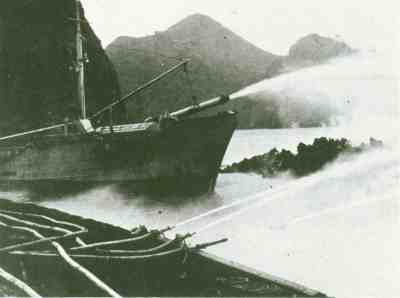
I'm kind of skeptical about this. Methods of stopping or diverting lava flows have been tried for centuries, with varying success. The Neapolitans called on their patron San Gennaro to turn away lava flows produced in the 1631 eruption of Mount Vesuvius (although one would think that the flows "spared" Naples more because their supply was cut off than because of the intervention of a 4th-century martyr). The Icelandic town of Heimaey was able to use seawater cannons to partially divert lava flows from closing off the entrance to their harbor in the eruption of Eldfell in 1973. (I seem to remember there were some questions as to whether the flows were diverted because the method actually worked, or if there was some change in the eruption that slowed down the effusion rate anyway - I'll have to check on that.) And in 1935, 1940 and 1942, Mauna Loa lava flows threatening Hilo were bombed in an attempt to keep them from reaching the city (with no significant effects, although studies since then have suggested that better targeted aerial bombing "has a substantial probability of success for diversion of lava"[Lockwood and Torgerson, 1980]).

(Above, USGS image of ships pumping seawater onto the forward margin of the Heimaey lava flow, Photograph courtesy of Sigurgeir Jónasson, March 1973. To right, B-18s over Mauna Loa eruption, April 1940, from the Hawaii Aviation website.)

And, of course, there's always the Jersey barrier solution employed by Tommy Lee Jones in Volcano.

While I'm sure that the chemistry behind the new idea is sound, I have questions about the physical aspects of the situation. A lava flow, even a really fluid one, has a lot of mass, and the source of the flow is constantly adding more. A flow doesn't stop unless its source stops producing lava. It can sometimes be diverted (naturally or not), but more often than not it's simply going to go around or over an obstacle, and keep on moving in the same direction as before. Then you have a whole new set of problems: Where is the diverted lava going to go? How long will the barrier last, and if it fails, are you going to have lava going in multiple directions? This is the very reason that Volcano's Jersey barrier solution was unrealistic - even if they could hold back the lava in the first place, the lava had to go somewhere, and with that kind of force, the barriers wouldn't last very long anyway.

Knowing the capability of lava flows for pretty much bulldozing over anything in their way, I don't think that building a limestone wall in the way of one would be very effective. I could be wrong, though; basaltic lava flows on Hawaii become channelized all the time by their own debris, and I suppose if you were able to dump enough limestone on one in strategic locations, you might be able to divert it. I do think, despite being skeptical of the idea, that it would certainly be really cool if it did work. Not to mention that it might actually be affordable, since limestone is common in nature and used widely for construction. (More affordable than bombing, anyway.)

Come to think of it, Jersey barriers are made out of concrete. Concrete contains cement, and cement is made partially out of limestone. Hmm. Maybe TLJ had something going there...


References:

"Volcano taming: Could geochemistry save lives during volcanic eruptions?" (Eurekalert)

Schuiling, R.D., 2008, How to stop or slow down lava flows: Int. J. Global Environmental Issues, 2008, vol.8, p.282-285 (Link to abstract)

Man Against the Volcano: The Eruption on Heimaey, Vestmannaeyjar, Iceland (USGS Publication)

Lava-Cooling Operations During the 1973 Eruption of Eldfell Volcano,
Heimaey, Vestmannaeyjar, Iceland
: U.S. Geological Survey Open-File Report 97-724

Lockwood, J.P. and Torgerson, F.A., 1980, Diversion of lava flows by aerial bombing — lessons from Mauna Loa volcano, Hawaii: Bulletin of Volcanology, vol. 43, no. 4, p.727-741. (Link to abstract)

Sunday, December 23, 2007

The Gods must be restless? Take a look at the scientists.

I just finished reading the most recent National Geographic, and I spent some time thinking about Andrew Marshall's article, "The Gods Must Be Restless". In it, he talks about some of the beliefs that have grown up around Indonesian volcanoes - and there are a lot of them, considering that Indonesia has the most active volcanoes of anywhere in the world.

I found myself conflicted about the attitudes of some of the people who live in the shadow of these volcanoes, especially the Gatekeeper of Merapi. While I can certainly understand the importance of respecting beliefs and traditions of the Indonesian poeple regarding their volcanoes, it almost seems criminally negligent of their spiritual leaders to ignore or even oppose the efforts of scientists and local civil authorities to alert them to the dangers they face. Scientists are sincerely trying to help, and it seems that they're hitting an impossible situation: if people don't heed their warnings because local spiritual leaders say not to, and nothing happens, then people are more inclined to trust them than the scientists; if they choose not to listen and something does happen, the scientists are blamed for not trying hard enough, or telling them sooner, etc. (I know this isn't always the case, and that many people take the scientists very seriously, but it's those few who don't that make things difficult for everyone.)

I'm reminded of Harry Truman at Mt. St. Helens, or the Aetas on Pinatubo. It boggles my mind that people somehow think that volcanologists are somehow trying to advance personal agendas or take their land or otherwise screw them over. Every volcanologist I've ever met has certainly not been in the job for the money or the prestige - they're working in the field because they're passionate about it, and they care about making people's lives safer. Those are my motivations, at least. I want to specialize in volcanic hazards mitigation because I love volcanoes, AND because I want to use my skills to help others. And it's why this article has touched on such a sore spot. I know I'll come across this sort of bias and willful ignorance in my work, and I hope I can prepare myself to deal with it, but I really wish it didn't exist.

And the quote that suggests the Merapi Gatekeeper thinks "the alerts are merely guesses by men at far remove from the spirit of the volcano"? That just makes my blood boil. How can you not be in touch with the spirit of a volcano when you're listening to it breathe, feeling its pulse under your feet and watching it bleed molten rock and explode with all the violence of a savage beast? How can you not feel a connection with something like that? Just because I will use electronic equipment and the latest technologies to monitor a volcano doesn't mean I won't also fight up and down its slopes, and get ash and mud under my fingernails, and make a thousand little blood sacrifices in my efforts to learn about it. To me, a volcano can't be anything other than a living thing, one with its own personality and temperment, and I take offense at anyone who says that I can't forge a connection with it because I am a scientist.

Now, I won't deny that superstition can have its place in dealing with volcanoes. I myself took the precaution of leaving tokens for Pele on my last visit to Hawaii (especially after the strep throat and ear infection I picked up after my first trip, where I did do some legal sample collecting off National Park land). I'll probably do the same thing again wherever I end up studying volcanoes for graduate school. But when people have their heads buried so thoroughly in their superstitions and rituals and traditions that they ignore the efforts of the scientists who are trying to protect them? That's when I start to get angry.