
Showing posts with label advice. Show all posts

Tuesday, September 14, 2010

A question of time

*Note: Having been temporarily flattened by my yearly fall cold, I'm putting up a non-geology post that I was working on earlier this month and have just enough energy to finish now. I'll make it back to talking about andesitic eruption deposits just as soon as I emerge from the haze of cold drugs.

'Tis the season for the arrival of new grad students (geology and otherwise), and 'tis also time to talk about time. As in, time management - possibly one of the most important skills a grad can have (or develop).
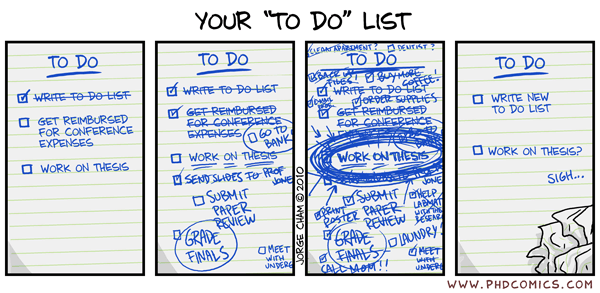


You've heard it a lot of other places, but I'll repeat it here as well: Graduate school isn't like undergraduate, unless you were part of a crazy tough undergrad department. You're much more responsible for yourself, including how you portion out your time between classes, research, work (if you happen to be a TA), and downtime. I treat it as a job, because that's what it should be. And it's really, really important to know how much time to devote to the different parts of your job - and when to take a break.

Classes will be important, but unlike undergrad, they're not the biggest part of your life. Most grad programs will expect you to maintain a certain GPA of to remain in the program, but you shouldn't be working yourself to death over your classes. Eventually, you won't be taking as many (or any at all), and if you're not used to working on things other than classwork, it will be harder to adjust. Pace yourself if you can - sometimes you can put off a class that's not essential to your research. 

Likewise, if you're TAing, remember that the teaching experience is useful - and if you plan to be a professor someday, it may be some of your only training - but that research is your primary mission. Put in the work that you need to, but don't get sucked into agonizing over grading or class preparation. Ask for help if you need it, from your professor or the other TAs. Don't get too emotionally invested in it; not every student is going to like you or your teaching style (or their grades).

Research should be the main focus of your time in grad school. Even if you don't have a solid idea of what you want to work on when you come in, start by doing as much reading as possible (without frying your brain). Use your class projects to help develop (and answer!) research questions. Set daily, weekly and monthly goals for yourself, and keep track of things like conference deadlines and committee meeting dates (they're good things to schedule your work around). If you have an idea for a research proposal, start writing whatever you can, a little bit at a time - it will save you a lot of work come crunch time. Keep a calendar (or two) to remind you of your appointments; being able to look ahead at a deadline will help you plan out your time better. 

And most importantly, remember to take time for your own well-being. It's really, really easy to get overstressed in grad school. Between teaching, research, writing, taking classes, and dealing with everyday life, you're going to be really busy. You may well be putting in longer hours than a regular job, just to get things done - and that's okay. But make sure that you take time off for yourself, because your mental health is just as important as your degree. I feel like I came from a rigorous academic background, and I still had rough patches getting adjusted to grad school; everyone does. But I learned that I had to step away from it and do fun things for myself - hiking, shopping, going out with friends, watching cheesy horror movies, blogging, etc. It's made the whole experience a lot more enjoyable, and I think that even though grad school is difficult, if you're not enjoying it on some level, there's something that needs to change. 

Sunday, October 26, 2008

Don't let them see you sweat

One of the students in my intro lab was chatting with me in class recently and mentioned that she was planning on applying to grad school, and wanted to know if I had any advice for being a TA. Now, I'm still working the bugs out of the process myself, since I've only been doing this for a few months, but it did get me thinking about what I should tell her.

Our situations are a bit different - I'm in science, while she'll be looking for programs in performing arts, and will likely be put in charge of a full course rather than a lab section associated with a course. What isn't likely to be too different, though, is that she'll be entering with little or no preparation in how to teach a class, aside from maybe a few days in a "crash course" seminar (like I had in August).

I didn't actually find that seminar to be very helpful, mainly because it seemed geared toward students who would be teaching introductory courses in which they were mainly responsible for choosing the course layout - developing their own syllabus, readings, assignments, etc. I don't do that - we get pre-written labs that roughly parallel what the students are learning in lecture, and maybe do a little additional lecturing on the side. So attending a seminar where we learned "think-pair-share" and other active learning techniques was neat in theory, but not really applicable to a structured setting like a lab course. (We did have one short session on teaching labs, but I was so annoyed by the fact that the invited TA wouldn't shut up and stop talking over the professor who was running the thing that I didn't get much out of it.)

Anyway, the gist of it is that I've either been relying on advice from other TAs or learning on my feet. This is both good and bad; the good is, you find out really quickly what works and what doesn't, but the bad part is, my first class of the week usually gets shorted in terms of quality of teaching because they end up being the guinea pigs. My TA group does get together and go through the labs and experiments beforehand, but there's a big difference between when we do the lab and when the students have to do it; we often find that something that makes sense to us is totally incomprehensible to the class. This doesn't do much for my nerves. I apparently don't show it, but I get really nervous about standing in front of a bunch of people and being responsible for them learning something properly. I'm always worried that I won't teach something in a way that makes sense, or that I'll get something wrong and then be embarrassed about it in front of a bunch of people who aren't all that much younger than me.

Fortunately, I realized something early on: The students don't know when you make a mistake, they don't usually remember it unless it was something really stupid, and for the most part, they're not out to get you. Some of them really want to learn and some of them just want to pass and finish their science requirement. A few will want to go on in the field, and you want to try and do the best job you can for their sake, so they don't have to relearn it later - but you shouldn't let it totally consume your time or attention.

So here are a few more of the things I've learned so far:
  • Make sure you know what you're going to teach ahead of time. If you need a powerpoint, don't wait until five minutes before class to put it together; if you're talking about a reading, read it; if you're doing a lab, try it out so you know where your students are likely to screw up.
  • If you're in grad school and you have a TAship, someone thinks you're competent enough to be in front of a class. Try not to doubt your ability to teach.
  • Don't give them the answers, but don't not answer questions. Lead them; say "How would you solve this problem?" Make them go through their process and point out where they might be going wrong.
  • Group work sucks - there's no way to get around that. Group work in class works better than group work on projects, though - if you're not around to watch, someone will always end up doing all the work and someone else will slack off. Be cautious about assigning out-of-class group work.
  • Anecdotes and analogies keep people interested. (Students have much more fun learning about impact cratering when you let them throw pumpkins off the roof of the building, for example.)
  • Unless you're really doing a terrible job, your salary doesn't depend on their end-of-semester evaluations. Not everyone is going to like you all the time, but as long as you make sure that they understand what you're teaching (ask them!), you don't have to be the "cool" TA. (Although that helps...)
  • Don't stress over the ones that choose to fail - and by this I mean people who just don't make any effort, not the ones who do the work and ask for help and still don't do well (keep plugging for those). You're responsible for letting someone know that they're doing badly, but they need to come to you for help. Don't spend all your time chasing them around.
  • Don't take yourself too seriously! Expect courtesy and respect from your students, and give them the same, but don't forget that you're all just students - joke a little, sympathize when they have midterms, ask how their plays or sports competitions or concerts went.
So far, I'm finding that I enjoy teaching, at least for the short time I do it every week. I don't know that I'd want to make a career of it, or that I'd want to teach more involved and larger classes, but for now...hey, it's not so bad!