Showing posts with label graduate school. Show all posts

Tuesday, September 14, 2010

A question of time

*Note: Having been temporarily flattened by my yearly fall cold, I'm putting up a non-geology post that I was working on earlier this month and have just enough energy to finish now. I'll make it back to talking about andesitic eruption deposits just as soon as I emerge from the haze of cold drugs.

'Tis the season for the arrival of new grad students (geology and otherwise), and 'tis also time to talk about time. As in, time management - possibly one of the most important skills a grad can have (or develop).
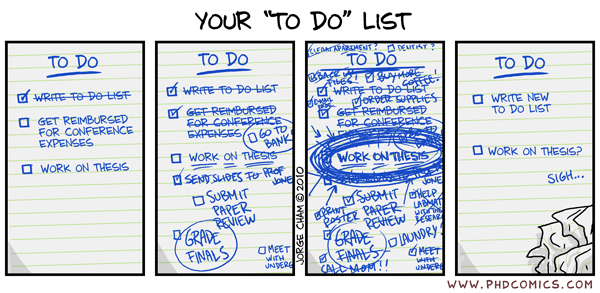


You've heard it a lot of other places, but I'll repeat it here as well: Graduate school isn't like undergraduate, unless you were part of a crazy tough undergrad department. You're much more responsible for yourself, including how you portion out your time between classes, research, work (if you happen to be a TA), and downtime. I treat it as a job, because that's what it should be. And it's really, really important to know how much time to devote to the different parts of your job - and when to take a break.

Classes will be important, but unlike undergrad, they're not the biggest part of your life. Most grad programs will expect you to maintain a certain GPA of to remain in the program, but you shouldn't be working yourself to death over your classes. Eventually, you won't be taking as many (or any at all), and if you're not used to working on things other than classwork, it will be harder to adjust. Pace yourself if you can - sometimes you can put off a class that's not essential to your research. 

Likewise, if you're TAing, remember that the teaching experience is useful - and if you plan to be a professor someday, it may be some of your only training - but that research is your primary mission. Put in the work that you need to, but don't get sucked into agonizing over grading or class preparation. Ask for help if you need it, from your professor or the other TAs. Don't get too emotionally invested in it; not every student is going to like you or your teaching style (or their grades).

Research should be the main focus of your time in grad school. Even if you don't have a solid idea of what you want to work on when you come in, start by doing as much reading as possible (without frying your brain). Use your class projects to help develop (and answer!) research questions. Set daily, weekly and monthly goals for yourself, and keep track of things like conference deadlines and committee meeting dates (they're good things to schedule your work around). If you have an idea for a research proposal, start writing whatever you can, a little bit at a time - it will save you a lot of work come crunch time. Keep a calendar (or two) to remind you of your appointments; being able to look ahead at a deadline will help you plan out your time better. 

And most importantly, remember to take time for your own well-being. It's really, really easy to get overstressed in grad school. Between teaching, research, writing, taking classes, and dealing with everyday life, you're going to be really busy. You may well be putting in longer hours than a regular job, just to get things done - and that's okay. But make sure that you take time off for yourself, because your mental health is just as important as your degree. I feel like I came from a rigorous academic background, and I still had rough patches getting adjusted to grad school; everyone does. But I learned that I had to step away from it and do fun things for myself - hiking, shopping, going out with friends, watching cheesy horror movies, blogging, etc. It's made the whole experience a lot more enjoyable, and I think that even though grad school is difficult, if you're not enjoying it on some level, there's something that needs to change. 

Wednesday, January 27, 2010

Hooray!

Quals are over and passed (pending some proposal rewriting and me promising to take a thermodynamics class in the near future). It's nice not having that stress hanging over my head - now I can relax and get some research done! (Not to mention getting back to blogging more often...)

Saturday, October 24, 2009

GSA Update #3

I always head to GSA with good intentions (i.e., actually writing about things the day they happen), but I usually end up joining the ranks of those catching up with their writing instead. (There's nothing wrong with this, since I'm not getting paid to write on a schedule or anything, but it annoys me when I do it.)

Tuesday at GSA was another great chance to see talks; lots of discussion about volcano hydrothermal systems, degassing, hazards, and risk communication. In addition, I (and Jim Lehane from Dino Jim's Musings) were asked to be on a the eGSA ad hoc committee! We had a really interesting discussion about how GSA communicates with its members online, and ways that we can incorporate new technology to help GSA keep up with current online trends (such as geoblogging). Some exciting topics came up, including the possibility of a GSA blog, an improved GSA Connection newsletter and maybe even a meeting-oriented Iphone app.

Anyway, on to a few talk summaries:
  • Conduit convection vs. deep degassing at open vent volcanoes: melt inclusion evidence from Popocatepetl Volcano, Mexico by Paul Wallace. In this study, melt inclusions were found to indicate variable degassing at different depths in a volcanic system; CO2/SO2 ratios of volatiles dissolved in the inclusions were used to determine the pressure and depth of exsolution. The CO2/SO2 relationship is something that I was taught about in a volcanology field course I took in Hawaii; CO2 degassing occurs at depth and SO2 degassing when the magma reaches a more shallow location, and increasing amounts of SO2 are often taken to indicate a likely eruption (or at least magma moving into a shallow part of a volcanic conduit).
  • Back off: We're scientists! Myth vs. reality and how to communicate risk related to natural hazards by Jeff Rubin. Jeff was one of the teachers of the short course I took on Sunday, and this talk was a great summary of the important points that came up during the discussions he led. One of the biggest problems with mitigating natural hazards is the assumptions that people in charge make about how non-scientists and non-officials will behave - especially thinking that they will panic. In reality, panic is extremely rare and in many cases precious resources and personnel are wasted on trying to prevent it. What folks in charge should be concentrating on is communicating clearly and honestly about hazards, and maintaining credibility (by not withholding information unnecessarily, or refusing to admit a lack of certainty, for example).
  • The preacher vs. the volcanologist: Origin of the word "pyroduct" by Jack Lockwood. This was one of the history of geology talks, and it was a great tale about Reverend Titus Coan, who went to Hawaii in the 1850s to help spread Christianity to the natives and in the process made some important observations about volcanoes, and the more famous James Dana (of Dana's Mineralogy), with whom he corresponded. Coan's letters to Dana about eruptions at Mauna Loa were the earliest field descriptions of activity at that volcano, and they caused a long-standing argument between the two about the existence of lava tubes. In short, Coan described them and Dana (who had not been to the field and actually looked at them) republished his work but denied that lava tubes (or "pyroducts", as Coan called them) existed. (Only after Coan's death did Dana even partially relent, in fact.) Dr. Lockwood left us with a moral to the story: Good field observations trump office speculations every time!
  • Blogs as a resource and social support network for women geoscientists by Kim Hannula (of All of My Faults Are Stress Related). I was really looking forward to this talk, because it presented the results of one of the surveys that's been bouncing around the geoblogosphere in the past months. The point of the survey was to find out why women read (and write) geoblogs, and the results were pretty interesting: women geoscientists in academia read and write blogs to make their experiences feel more normal, and to get advice and connect with role models. This wasn't so much the case for geoscientists in industry, and Kim has promised some further research on why the responses were different. You can read her summary here - as one of the PIs of the study, she's better at summarizing it than I am!
In the course of the meeting, I also helped out at UB's recruitment table, and it was really nice to get to meet prospective grad students and try to get them excited about grad school. It wasn't just an opportunity to talk about how great UB's volcanology group is (although I definitely did), but also a chance to answer questions about grad school in general, which is really valuable for incoming students. There are a lot of things that I found out by trial and error, and if I can make it easier for someone else, I'm all for it. There was a great turnout (and not just for the swag), and I'm looking forward to see who comes to visit in the next few months.

And on Wednesday, I rested....just kidding. On Wednesday, noticing a lack of volcanology-related sessions, I decided to tromp around Portland for a bit. Sadly, it was a pretty soggy morning, and most stores didn't open until 10 (which probably kept me from spending money on things I'd have to stuff into my already-full bags), but I enjoyed the chance to see a bit of the city. I'll have to go back and visit some volcanoes, because I didn't see any in the whole time I was there. Darn!

All in all, a great meeting - it's not often that there are talks on volcanology every day, and I felt like I learned a lot and made some good connections. (And I couldn't beat the geobloggers meetup for a good time!)

Thursday, September 10, 2009

Speaking well

I won't touch on the political parts of the President's speech Wednesday night (or the fallout from adults not being able to behave like adults, on both sides), but I do want to write about the way in which it was delivered.

Public speaking is a big part of being a geologist, whether you're talking to a lab section, lecturing to a class full of hundreds of people, or giving a talk at a conference. One of the things that my professors and other mentors have stressed, many times, is the importance of speaking well - and that doesn't just mean being able to intelligently discuss your subject material, it means making it interesting. I could be talking about a volcanic eruption, which is one of the most flashy and exciting processes that goes on in geology, but if I gave the talk in a boring way, it would leach all the excitement right out of it.

Because I think President Obama's address was an excellent example of rhetoric, I'm going to use him as a guide to good speaking techniques. (NOTE: This doesn't necessarily mean that I remember and use all of these techniques when I'm speaking - I still get nervous during class presentations, and I have a number of bad habits I could get rid of. But I know what I can work on, and these are good examples of those things.) You can bring up videos of Obama's recent health care speech to see what I'm talking about, as well as videos of the other people I mention.
  • PRACTICE: This is the single most important thing you can do before giving a talk. You can bet that every single president has had speech coaches at one point or another, and that no one goes out and delivers a State of the Union address, for example, without having gone over it a few dozen times. President Obama probably practices enough to memorize most of his speeches, since he doesn't spend much time looking at his notes or a teleprompter. Since that's not always possible for someone giving a lecture to a class or presenting a class project, for example, at least make sure you know how your talk progresses - memorize the main points you want to get to, make notecards to remind you, and deliver the talk to your friends, parents, pets, potted plants, walls, etc. The more comfortable you are with your subject matter, the better your talk will be.
  • Posture: This is your stage dressing. If you slouch or hunch or turn away from your audience or stiffen up during a speech, they'll read your body language and deduce that you're not happy or comfortable or interested in the material. If it's not worth your time, why is it worth theirs? President Obama is very good at standing straight but not looking uncomfortable about it; he also turns and moves a little to keep from seeming glued in place. (The more recent former President Bush was all right at this, but he also tended to cling to the lectern during his speeches, so he came across as stiff and uncomfortable.) It's not good to take this too far and start rocking back and forth, though; that's just as annoying.
  • Hand motions: These are really important for underscoring your speech. Hand motions can put emphasis on a point or help your words flow. Combined with your tone of voice and volume, they can make something really memorable, or indicate that one part of the speech is important but not the main point. President Obama is great at using hand motions, and it makes his speeches very emphatic. On the other hand, one reason that former President Nixon is so painful to watch is that he has terrible timing, and his gestures don't match what he's saying. It's like watching someone else control his body. Also, if you're not comfortable using your hands, don't cling to the lectern or wave the laser pointer too much or bang your pointing stick on the floor (or your feet). I've seen people do all of these things, and they're awkward and distracting.
  • Eye contact: This is a trick they taught us at our TA training - pick a person in the audience and look at them for a little while. Make your audience feel like you're addressing them and not just the back wall. I'm pretty sure the President does this, because he's shifting his eyes around the room when he talks, and he's not staring at the teleprompter or his notes. Probably most of us still need notes for a long lecture, and don't have teleprompters, but it's a good idea to look up at your audience more often than you look down.
  • Tone & volume: Talk loudly enough to be heard, but modify your tone as appropriate, and don't talk in a monotone (remember Ben Stein? Audiences hate that). Be a little louder and more emphatic when you're making an important point, and pull back a little when you want the words to flow. Singers do this; it's the reason they get louder or softer, choppy or smooth, to give the appropriate emphasis to the lyrics they're singing. You don't want to trail off into mumbling or speak like a robot, because it gives the impression that you don't think it's important; modulating tone and volume keeps the audience interested.
  • Enunciation: Nothing is worse than a mumbling speaker. If your audience can't understand you, they'll stop paying attention. In addition, make sure you're pronouncing words correctly - it makes you look bad when you mispronounce a word, and it's easy to get an incorrect pronunciation into your head. Look it up beforehand; use Dictionary.com or a colleague. (I absolutely hate it when people say nuclear "nuke-u-lar", for example. This is not a dialect or an accent thing; it's just wrong.) President Obama speaks very clearly and loudly, and I suspect that he could have given his speech without microphones and everyone would have heard it just fine.
  • Stalling tactics: Saying "um" a lot erodes your poise and is, frankly, painful for the audience. Stalling words ("um", "ah", etc.) are sometimes necessary, though, especially if you're thinking about the answer to a question (because most people don't speak how they write). If you must pause or stall, think of other ways to do it, and work on getting comfortable enough that you don't do it (in speeches or lectures, at least). Rephrase the question or make an easy comment before going on to your answer. Presidents giving speeches usually have teleprompters and can avoid this, but stalling techniques come out when they have to answer questions at press conferences (this is true for pretty much everyone, including President Obama). Also, "like" isn't an acceptable stalling word ever. It's really immature and older listeners find it annoying (and grammatically incorrect, to boot.)
It's not easy to remember all of these, of course, but the best speakers try to incorporate at least a few things (with practice being the most important one). Someday I hope I can be as good a speaker as the people who've taught me, and in the meantime I'll keep on working these tricks and techniques into my class presentations, conference talks, and anywhere else I can.

Monday, August 31, 2009

O_o

I don't usually use emoticons for post titles, but today warrents one.

Apparently, everyone at UB had an 8 or 9 AM class today, and they ALL DROVE TO SCHOOL. Meaning parking was gone by 9. Not 10, not 11 - 9 AM. And there were traffic jams. (If you've ever been to Buffalo, you'll know that traffic jams of any sort are usually pretty rare. And by my DC-area standards, Buffalo has practically no bad traffic.) UB is also pretty good with parking space, but it seems that we've acquired a whole bunch of new students who don't live on campus and haven't figured out the bus system yet.

Sheesh. I'd bike in except I'm doing physical therapy for my knees and my therapist has forbidden me to ride that much.

Sunday, August 30, 2009

A new semester

For me, this means some welcome changes. As a result of earning an NSF Graduate Fellowship, I don't have to TA this year, so I actually have more time to sit down and work on my own research (instead of spending a lot of time - including whole weekends at one point - just keeping up with grading). This also means that my committee has been encouraging me to take advantage of said funding and go for a PhD, but more on that later.

One interesting thing that happened to me last week was that I was asked to be a group leader in UB's training conference for TAs. This is a two-day gathering in which TAs, new or otherwise, meet to learn about teaching techniques, how to handle a classroom, academic honesty/dishonesty, etc. For new TAs, it might be the only chance they get to acquire a little classroom training before they find themselves in charge of a classroom (something that I wrote about last year around this time). I still find this ridiculous; just because you've made it to graduate school doesn't mean you're qualified to teach, although there are certainly a lot of great TAs out there who manage just fine.

Another unsatisfying aspect about the conference is that it wasn't geared toward science students. In fact, most of the bigger science departments at UB hold their own version of the conference, which I think would be much more useful. Fortunately, the geology department is moving toward that idea. I think a hybrid, where we invite some of the speakers from the regular conference to come and present, as well as having current geology TAs and professors work with incoming grads, would work well.

There were aspects of the conference that worked well, though. At the end of the final day, groups meet to hold micro-teaching sessions where each person gives a five-minute lesson on a topic of their choice. It doesn't need to be in their discipline; I've seen people teach their groups about how to shave, how to brew beer, how to decipher binary, and the best way to catch and eradicate an invasive saltwater fish. The catch is that these presentations are taped, and everyone gets to watch themselves (and their groupmates), and critique each other. Because it's hard to see yourself when you're in front of a class, you get the benefit of evaluating your own performance, and you get constructive criticism from your peers. (Inevitably everyone cringes to see themselves on tape - even me - but they also usually say that the micro-teaching is the most helpful part of the conference.)

So in the end, there rae good and bad things about the TA conference. For new TAs, like I was last year, it's a bit of a lifeline - maybe the only chance they'll have to learn how to teach before they're responsible for their own classroom. For returning TAs, it can be a reminder of things that they've forgotten in the grind of trying to get everything done, cover the whole lab book, grade all the papers. But as I mentioned, treating all the conference-goers as if they're automatically going to be in the position of professors isn't as helpful to TAs who are mainly going to be running labs or recitation sections, especially if their department doesn't yet have their own training session.

I am curious about what other people have experienced, though. Is this a common thing at other schools? Did any of you get special training before you found yourself in front of a classroom, or did you wing it and hope for the best? What advice would you give to incoming TAs? (If I get enough responses, I'd like to do another post on tips for TAs - so please comment!)

Tuesday, April 21, 2009

Funding resources for geology graduate students

I have a bit of a plea for the geoblogosphere this week. I've volunteered to do some website work for the geology graduate student association here at UB, and one page is going to be dedicated to useful resources. I'm compiling a list of Earth science-related scholarships, grants and fellowships, and I want to make sure that I don't miss anything.

Can everyone have a look at what I've come up with so far, and tell me what I can add to it?

Here's the rundown
(I've left off a bunch of the organization names to save space):

AAPG Grants-in-Aid
AASP Student Scholarships
AAUW American Fellowships (Dissertations)
AAUW Career Development Grants
AEG Foundation Research Fund
AEG Tilford Fund/Scholarship
AGU Mineral and Rock Physics Outstanding Student Research Award
AGU Student Travel Grants
ASPRS Awards & Scholarships
AWG Chrysalis Scholarship
AWG Winifred Goldring Award
AWIS Educational Foundation Predoctoral Awards
Clay Minerals Society Student Research Grants
Clay Minerals Society Student Travel Awards
Department of Energy Co-Op Jobs
EPA GRO Graduate Fellowship
EPA STAR Graduate Fellowship
Farouk El-Baz Student Research Award
Fred L. Scarf Award
Graduate Fellowships in the Physical Sciences
GSA Graduate Student Research Grants
Horton Research Grants
Lemke Scholarship Fund
Marliave Fund/Scholarship
Martin L. Stout Scholarship
MSA Grant for Research in Crystallography, Mineral Physics, Mineral Chemistry, and Mineralogy
MSA Grant for Student Research in Mineralogy and Petrology
NASA Graduate Student Researchers Program
National Defense Science and Engineering Graduate Fellowship
NOAA Educational Partnership Program
NSF Graduate Research Fellowship Program
Paleontological Society Student Research Grants
Patterson Memorial Grant for Field Work
Science, Mathematics And Research for Transformation (SMART) Scholarship
SEG Foundation Scholarship Program
SEG Student Research Grants
Sigma Delta Epsilon Graduate Women in Science Fellowships
Smithsonian National Museum of Natural History Graduate Student Fellowships
Spackman Award
WAIMME Scholarships

Suggestions? Advice? Shameless plugs for something you're involved in?

PS - I'm setting this up for students at SUNY Buffalo, so anything that's limited to a particular school, or a state or country that isn't New York or the US is no good.

Monday, April 13, 2009

Just a little celebrating

I usually try to be modest, but I'm just so excited by this that I felt like posting:

NSF Graduate Research Fellowship Awardees


(Sorry for the repeat, folks who follow on Twitter - it's only this once, I promise!)

Not only am I the only applicant from UB that received an award, I beat out all the engineering, medical and life science applicants - and at UB, we have a lot of those.

It's actually a big relief, too - I don't have to worry about how to pay for my next trip to Guatemala for field work, or having to borrow money for tuition, or (and this is the big one) moving to a cheaper apartment next year. Woohoo!

Here are the numbers:

This year, 30 out of 950 award recipients were for "Geoscience" (~3.2%)

For the past few years, the breakdown of applications looks like this:

Representation of Submitted Applications by Gross Field


2008
2007 2006
Total Number of Applicants 8582 8339 8162

% % %
Chemistry 6.6 6.4 6.7
Computer and Information Science and Engineering 5.3 5.4 6.4
Engineering 27.5 26.2 25.2
Geosciences 3.1 3.3 3.8
Life Sciences 29.1 30.0 28.3
Mathematical Sciences 2.9 3.2 3.0
Physics and Astronomy 5.3 5.5 6.0
Psychology 8.4 7.5 7.6
Social Sciences 11.9 12.5 13.0

So, for 2009, the geoscience winners represent ~3.2% of the total awardees - on a par with the application rate for the past few years, but boy, does that seem low to me! NSF's restrictions on applying - having no more than 1 year of graduate experience, no matter what degree you're starting - do make it a bit difficult. I think it's definitely unfair that PhD candidates can't apply unless they've come straight from undergrad or work (although a PhD who has an MS already would have a bit of an advantage in writing and experience over one who doesn't).

Still, I think we need to up the representation for the geosciences - and I know there are capable students out there! It's a pain getting the thing written in time for the deadline, but boy, is it worth it.

Monday, September 15, 2008

Anxiety

One of the things I least like about myself is my habit of getting very anxious and upset over odd things. Strangely enough, this doesn't happen for big events - I've defended an undergrad thesis, presented a poster at a conference (and not in the undergrad section, either), started teaching intro geo labs, walked on hot lava, and (totally unrelated to geology), performed a Tchaikovsky symphony in a concert with the National Symphony Orchestra at the Kennedy Center.

Oh, I get nervous, sure. But somehow the nerves don't really screw me up for the big things. It's other things - buying a piece of furniture that I turn out to hate (actually, a lot of impulse buys do this to me), or hearing people talk about what great deals they have on their rent and feeling like I'm an idiot because I didn't find the same, or not wanting to turn on the heat because I'm afraid I won't be able to afford the bill, or spending that extra money on sushi because I can't stand to eat ham and cheese again. I get upset about stupid things. I have the feeling that I would be perfectly fine if I had to deal with, say, an earthquake, or a volcano suddenly sprouting up in my backyard (unlikely), or some other natural disaster; but something that I could possibly feel guilty about really screws up my day.

I guess this means I have the opposite of performance anxiety. I don't think it's bad enough that I need to get medication for it, but it's certainly not helping me get through the day.

I do remember feeling like this when I was starting undergrad - not this bad, actually, because they kept us really busy and I ended up going home early in the fall because of a hurricane. But this time I think it's worse - I've moved several states away from home, I live alone, I have no family nearby, I'm just starting to make friends and I'm starting grad school, which is a major undertaking in itself. Not to mention I'm constantly worrying about money and classes and teaching and research.

I think I need more people around. My decision not to try and find people to live with was, I think, because four years of dorm living has turned me off sharing small spaces with people all the time, and because I didn't want to rush into a living situation that I might not be able to stand later. Unfortunately, that means once I leave school, my human contact for the day is over with, unless I call home. The entire situation stinks, and I'm going to have to start doing something about it before I convince myself that this whole thing was a bad idea.


On the upside, so you all don't think I'm really starting to get depressed, I'm getting a lot of reading done for my research. At the moment I'm delving into autofragmentation and mechanisms for pyroclastic flow formation, as well as lava dome structure and collapse triggers. Cool stuff - I'm glad I really get to dive into it, because I'm learning a lot.

Saturday, August 30, 2008

Questioning the system

Well, the Oreo activity hasn't happened yet, but my first lab sessions didn't totally freak me out, and none of the students walked out in disgust. I guess that means I'm doing well so far! (The first lab sessions are always hand-out-the-syllabus, anyway, which isn't particularly strenuous.)

I am questioning the general universe as to how I ended up with a Friday afternoon lab composed entirely of males, several of whom were obviously eying me with the "Hey, look, a chick. My good looks and charming nature are obviously going to get me an easy A." (Or something to that effect but less eloquent.) Good thing lab is only once every two weeks - half the crap to put up with. And, fortunately, they give us a roster with everybody's photos on it, so I can at least use their names when I tell them to cut the crap and do their work. (Honestly, I think they'll behave, but just in case...)

At any rate, starting my TA duties has made me think about the way that a geologist - or most any kind of scientist - becomes a teacher as well. It's one of the great failings of the sciences, in my opinion, that scientists who also want to become academics receive very little formal training in how to be a teacher. K-12 teachers, in most cases, receive extensive training, and usually have a degree in education and are formally certified. But scientists who teach, unless they spend time as a TA, or take classes on their own initiative, are not expected to go through the same rigorous training. They are, instead, dropped into a classroom setting and expected to know how to handle students, write lesson plans and syllabi, create exams, and oversee the education of possibly hundreds of young people who have been steeped in an entirely different method of learning. (I had exactly three days of "training" in a conference that was so generalized as to be somewhat useless to someone who's teaching in a lab setting, although it was really helpful to be exposed to some modern theories of education.)

What's more, the situation is self-perpetuating. Academic scientists succeed in their fields because they can excel in the lecture-based classroom, and when it comes time for them to teach, they tend to utilize the methods of the instructors they learned the most from. Perhaps some learned more from a professor who used active learning techniques, or some other alternative than lecture, but at some point they all end up teaching with lectures.

How in the world did we end up with a system like this? My college roommate, who now teaches high school chemistry, had to spend her senior year completing the equivalent of a masters in education, do weeks of supervised student teaching, and obtain a state certification before she could take on a classroom. I, on the other hand, will be plunked in a lecture hall with hundreds of undergrads and expected to develop a syllabus, lesson plans and testing strategy with practically no training (if I decide to become a professor someday). I certainly don't think that having a Ph.D. makes me more qualified than her to be a teacher, but our current system of academia does - at least as far as university-level education is concerned.

(Not to mention that I'm already totally, irrationally nervous about my teaching abilities in the first place. If I'm this insecure about being a TA, what the heck would happen to me if I did decide to become a professor somewhere? I'm sure it would be mitigated somewhat by the TA experience, but being an assistant and being the instructor are very different positions.)

So, geoblogosphere, what are your opinions? Do you think you were properly prepared for your teaching responsibilities, or would you have appreciated having formal training like a K-12 educator is expected to? Why do we still have this situation in academia, and what are your ideas about fixing it?

Sunday, August 24, 2008

Accretionary Wedge #12: Geology as a connector science

Hooray! I finally have both a working computer and internet connection. Definite cause for celebration, since I can now get back to blogging - at least as much as grad school allows, that is.

Even more cause for celebration: This is post #100! I think it's fitting that it should be an Accretionary Wedge entry, since at least part of the reason I started blogging was to connect with other people in the "geoblogosphere" - and what better way to do that than an online panel discussion? (Hey, there's that connection theme again.)

I've decided to write about something that's going to happen in a few days: I'm going to stand in front of an introductory geology lab and try to convince myself that I'm qualified to be teaching people who are only a few years younger than me. I expect that many of them will be freshmen, or non-science majors, who are in the class because they have to fulfill a science requirement. My undergrad classmates called this the "Rocks for Jocks" phenomenon, and we always laughed gleefully afterward, because we knew that anyone who picked geology because it was a "soft" science would be very surprised when they got to class. This phenomenon is also, in my opinion, at the root of the difficulties that science educators have keeping geology in science curricula at the K12 level. We as geologists all know that geology is one of the most inclusive sciences there is - but how do we get this across?

One of my main concerns is to make my labs not only fun for my students, but relevant to their lives. They're probably used to thinking of sciences as compartmentalized - this is chemistry, this is physics, this is astronomy, etc. I want to prove to them that not only is this untrue, but that they've probably used or relied on geology - and all the other sciences it incorporates - on a daily basis.

I'm planning on doing a short activity based on one that my mineralogy professor did early on in his course. I'll be handing out Oreos (knowing full well that food is an excellent tool for bribery), then asking the students to think about what goes into them (and the packaging). Once we've got a list, I'm going to ask them to tell me where each ingredient comes from, and how it is obtained. This is a great place to bring geology - and other sciences - into the discussion. Cocoa, for example, is commonly grown in tropical climates, and in rich volcanic soils (like in Central America). That chocolate flavor came (ultimately) from a volcano! The white filling is colored with TiO2, otherwise known as rutile, which can also be found in quartz crystals. There are minerals in that cookie! The plastic wrapper and tray are made from chemicals derived from petroleum products, which started as rotting leaves in a coal swamp teeny dead ocean critters hundreds of millions of years ago! And so on.

The value in the activity - aside from the brief boost in attention span resulting from sugar intake - is that they see the connections that science, and geology in particular, have to their everyday lives. Geology isn't just something that grubby, bespectacled rockhounds do off in the mountains somewhere; it's something that ultimately helps produce the food we eat, the packaging that keeps it fresh, the fuel for transporting it, the nuclear energy that runs the lights in the grocery store, and more.

Hopefully, in trying to communicate how geology is intimately connected to our lives, I'll also be able to get across how important it is to me, and how exciting I find it because of all those wonderful connections. And, according to the people in my three-day "how to not fail as a teacher" training session, getting your students excited about learning is the most important part of the job.

And there are some thoughts on connections, with a bit of wandering thrown in. (And after what I've gone through to get moved into a new apartment in a new state and trying not to panic about teaching and taking classes, I think I'm allowed a few tangents!)

Tuesday, April 15, 2008

Technically they're bison

Final decision is in, papers are signed in triplicate, faxed, emailed and overnighted, and it looks like I'll be going to SUNY Buffalo in the fall.

I want to thank everyone who offered me their advice over the past few days. I can be a remarkably insecure, nervous person when I have to make big decisions, and it was immensely reassuring to have people reinforce my gut feeling about the choice I had to make. While I loved Seattle and the University of Washington, I felt like I really couldn't pass up the chance to work with the group at SUNY Buffalo, especially since I would have the opportunity to do work at a volcano observatory and on active mountains.

And, as everyone has said, it's only for two years. I may think that the campus (the North one, anyway) looks like a prison complex and that Buffalo is a dreary former industrial city (which it is at this time of year), but I will also have a wonderful advisor, a great project and, since the cost of living is so much lower in Buffalo, I will not be extremely poor. Everything else is just details.

What really sucks is writing/calling everyone else to let them know I won't be working with them. I'm trying to be as polite as possible, but I still feel like a horrible person. And how the heck do I approach them later on, if I want to work on a PhD at one of those places? "Sorry I didn't choose you the first time around, but hopefully you can ignore that whole rejection thing?"

Oh well. Even if two years go fast, it's still two years. And I suppose they deal with this often anyway...but it doesn't make me any less uncomfortable. At least I can't dither anymore, since today's the deadline and everything is signed, sealed and sent.

Friday, April 11, 2008

Decisions

*Sigh*

And here I was thinking my final choice of grad school was going to be easy. I have to choose between the city I loved with a good program (though I would be working on more petrology and geochem than volcanology), and the city that doesn't thrill me, but with a great program (I would work on pyroclastic flows and volcanic hazards, which is exactly what I want to do).

Compensation for both is comparable, the people are all nice, but I really don't know what I'm going to do. It's only two years, after all... And it just seems incredibly awkward if you turn down a program that you might still want to go to later on.

I feel a headache coming on. I know the final decision has to be mine, but can anyone throw me some sage advice?

Monday, April 7, 2008

They may have 9 months of snow a year, but Broomball is teh coolness!

Just back from visiting Houghton and the campus of Michigan Tech, which means I only have one more grad school visit before the big choice. It might be hard; I've met some really great people in the past two and heard about interesting prospects for MS projects.

Turns out MT isn't cold all the time - we just had three beautiful, sunny and fairly warm days, which I was once again assured is not the norm. The interviews were tiring, as always, but I felt I got a good handle on the feel of the department, and luckily on Friday the students scheduled for my last meeting took us out to play frisbee instead of talk. There are only so many times you can give a "what I want to be when I grow up" spiel before your brain turns into mush.

Possibilities for Tech research are falling into the remote sensing and volcano seismology category, which could be cool even though I haven't had much experience with either and would be playing catch-up with physics and math classes. I briefly considered the Masters International Peace Corps program they run, which sends you out to a volcano as part of the Peace Corps for two years, but I don't have any experience in Spanish (most of the students go to Central or South America), and I wasn't quite ready to commit to three or four years to get a Masters. (Because of the way the Peace Corps schedules their training and deployment, some students will end up spending a year taking their masters classes, an extra semester waiting around, and possibly another semester afterward writing their thesis. That's a bit too long for me, not to mention that I'm too chicken to move to another country for several years. Maybe later, but not right now - I'll stick with moving to a different state for the moment.)

I'll post some photos of the campus and Houghton once I get home and locate the camera in the rapidly-accumulating pile of travel detritus that my desk has become. (And, I suppose I should explain what Broomball is for people who haven't heard of it.)

Monday, February 25, 2008

Sleepless in Seattle

As promised, I have an update on my latest travel experience, which was out to Seattle to visit the University of Washington graduate school. Surprisingly enough, the weather was fantastic - clear for three days in a row and not even cold! I was quickly informed by the grad students that this was highly unusual and that I had, in fact, been secretly transported to an alternate universe version of Seattle. I was pretty much happy to spend my entire visit within sight of a volcano, weather or no weather. Dealing with three time zones of jet-lag was much less fun, especially since my body didn't reset itself until I was ready to leave, but the grad students and profs at UW definitely made up for it.

Because I've never been on a flight to the Northwest, I was of course taking lots of photos from the plane. Unfortunately, I'm not sure exactly where I was for these, but here are a few. The first one is from somewhere over Montana vaguely near Great Falls; it's of a beautiful ring-shaped structure next to a small mountain range. My guess is either a caldera or an impact crater, and I'm leaning toward impact crater. Anyone know for sure?

UPDATE: Ron found the feature on Google Earth and informs me that it's the
Cayuse Basin, a breached structural dome. So much for my guessing abilities.


A little further on were some nice cirques (sans glaciers, as far as I can tell):


And of course, the best part of the flight: Mount Rainier! It was clear enough to see the summit and, far off in the distance, Mount Baker (I think), but this is the best of the pictures I took.


I really enjoyed the visit to U-Dub, which has a great campus - all Gothic architecture and trees and beautiful views. This is looking back toward the library (in the center of the photo) with the Earth and Space Sciences building on the left.


This is a view from the Pike Place Market looking south toward Safeco and Qwest fields, with (of course) Rainier in the background. As I said, beautiful clear days, which are apparently not common in winter.


And of course, a visit to the Market wouldn't be complete without a little fish-throwing:


All in all, it was a great trip, and made even better by the reception of the UW students and professors, who went out of their way to make the prospective grads feel welcome. Potlucks, personal guided tours and a seminar featuring John Clague as the guest speaker, not to mention the awesome, just-renovated facilities at the ESS building and the fact that the Pacific Northwest Seismic Network headquarters are in the basement. It was like a coolness overload for three days.

And you know, if I got to wake up and see Rainier every day, I wouldn't even mind the rain. (Especially if it decided to erupt...)

Tuesday, February 19, 2008

Brief update

Apologies for the lack of posting...being flattened by the latest bug wasn't what I had planned for this week. Fortunately, I managed to spend a productive weekend working with my undergrad advisor on the paper we're hoping to publish before I head off to grad school.

Thursday I'm flying to Seattle for the first of my grad school visits. I made sure to get a window seat on the plane - though I can't remember which side - and I'll hopefully be able to get some good photos while I'm flying across the country.

And, of course, I'm looking forward to seeing the Cascades for the first time. Lahar hazards aside, I think it's very cool that Mount Rainier is visible from the city - what volcanologist wouldn't want to wake up to that kind of view? (I'm probably going to end up with a few dozen shots of Rainier on the camera by the end of the trip, but hey, that's what 1GB memory cards are for.)

Thursday, January 24, 2008

Masters VS PhD

Last night's meeting of the Geological Society of Washington was quite fun - how often do a bunch of geologists get to hold meetings in a really swanky Washington landmark like the Cosmos Club, after all? (All right, they made us go in the back door so we wouldn't bother the real members, but it still felt exclusive.)

I also had the pleasure of meeting Callan Bentley of NOVA Geoblog, who was nice enough to give me some background on how the meetings work, and who has some very enthusiastic honors students (yay! more geologists). He's done a great writeup of the talk Derek Schutt (of the National Science Foundation) gave about the Yellowstone Hotspot. I was quite excited to see someone take a definite stance on the issue of whether Yellowstone is actually a "traditional" mantle-plume-driven hotspot; my experience with researching that issue for a class presentation several years ago (mostly using papers from GSA's Plates, Plumes and Paradigms, which had just been published) was that no one could really agree on what they wanted to call Yellowstone (or were leaning toward a lithospheric source, which Schutt's research disagrees with). My presentation involved a 'grant proposal' to do more seismic tomography surveys, which is exactly what Schutt and his colleagues ended up doing with Rayleigh waves - so I guess we were on the right track!

Excitement about the talks aside, one question that came up during a pre-meeting dinner was why I had decided to pursue a masters degree instead of going directly into a Ph.D. I actually had to think about that one for a moment. It was an issue that had come up during my grad school application process, since a few of the available scholarships for graduate research were geared specifically to Ph.D. students.

I suppose the main reason that I decided to apply as an MS student would be experience (or my lack thereof). While I did end up doing an honors thesis and presenting my work in the 'grown-up' poster session at GSA, I didn't think that necessarily meant I was ready to jump straight into a Ph.D. in volcanology - and especially not in hazards work. I simply haven't done enough work in volcanology to feel like I would be putting in my best effort as a scientist if I were to apply to a Ph.D. program. Sure, I've studied some ash flow tuffs and took a volcano monitoring course for a month last summer, but the fact remains that those were mainly undergraduate efforts, and my program didn't have any classes specifically in volcanology. Other students I've met so far have taken courses like that, and I felt a bit undertrained compared to them.

That said, I also want to spend as much time as I can doing pure research before I have to worry about finding a more permanent job. I suppose it's a bit self-indulgent, since I eventually want to do hazards mitigation work and it would certainly be better for the people I'd work with if I got out there sooner. But I don't want to miss out on the chance to do something fun for a couple of years before I have to face the difficulties of completing a doctorate. I'm also a bit of a traditionalist; maybe I could do just fine in a doctoral program, but why skip steps at this point?

Another concern of mine has to do with teaching. I'm not sure yet if I want to teach at any level of education. I've certainly considered the possibility, and I know that I'll be TAing classes as part of my graduate work, but beyond that I'm undecided. My big concern with the possibility is that I haven't had any formal training in how to teach - and even after I complete my graduate work, I probably still won't have had much! (This is actually a very puzzling aspect of college and graduate level science - the people who end up teaching are not actually required to have gone through the same sort of training that K12 teachers do. And then they're expected to have all the same skills as someone with an education degree. Who thought up this system?) At any rate, I want to have as much experience as possible in teaching, even if it's just TAing labs, before I even flirt with the possibility of becoming a professor - and that means taking the extra time to complete a masters.

Another part of the question that surprised me was the idea that masters students don't get funded. Hm. Interesting. Everyone I've spoken to about grad programs so far has told me otherwise; their students are either funded through grants or paid as TAs. Now, I've heard that students are encouraged and expected to apply to grant and scholarship programs in addition to this (or in some cases to replace it), but I don't think I've come across any program that will accept students without offering them funding. (I do know of a special case of one student who was accepted to a program where the professor ended up not having work for him to do for a year, but he TAed the whole time.)

I suppose this is another good forum for comments. What was your experience with choosing your grad school path? Were there specific circumstances that affected your choice? Do you regret going one way or the other?