Showing posts with label geology. Show all posts

Saturday, October 30, 2010

Geological Frightfest: The Monolith Monsters


Lee Allison at Arizona Geology deserves credit for inspiring the last movie in the Frightfest series - in his post from June about the Piranha 3D movie, he also mentioned The Monolith Monsters. Again, it's another 1950s movie I haven't had the chance to see, but I'll definitely have to remedy that if I can...guess what's next on the Netflix queue? With a title like that, though, I couldn't resist looking it up. And boy, this one is a doozy. Here's the IMDB summary:
A strange black meteor crashes near the town of San Angelo and litters the countryside with fragments. When a storm exposes these fragments to water, they grow into skyscraper-sized monoliths which then topple and shatter into thousands of pieces that grow into monoliths themselves and repeat the process. Any humans in the way are crushed or turned into human statues. The citizens of San Angelo desperately try to save themselves and the world from the spreading doom.
Wikipedia also expands on this with some dirt on some of the main characters, who happen to be geologists (though apparently not very good at on-the-fly rock identification):
In the desert region of San Angelo, California, geologist Ben Gilbert brings a strange black rock back to his office, where he and bored local reporter Martin Cochrane examine it but fail to determine its origin. That night, a strong wind blows a bottle of water over onto the rock, which begins to bubble and smolder. The next day, the head of the geological office, Dave Miller, returns to town from a business trip and finds the office destroyed by a huge growth of black rock and Ben dead, in a rock-hard, apparently petrified state.
Things certainly go downhill from there. The rocks spread via the pockets of students on a geology field trip, and pretty soon folks are turning into stone left and right. Not only are the rocks sucking silica out of people, but coming into contact with water allows them to grow and multiply. (Since humans only contain trace amounts of silica, these are obviously not very smart rocks.) The geologists eventually figure out that these are evil outer space rocks, and that salt water (???) will stop their growth. I won't tell you the thrilling conclusion, although it's there in the Wikipedia summary (spoiler alert!) if you want to read it.

This movie is impressive not only for the fact that it has evil space rocks sucking the silica out of people, but for its fantastically corny (and geologically incorrect) dialog. Here are a few gems:
"The desert's full of things that don't belong. Take the salt here. Used to be an ocean bed. Now that ocean knew that the middle of a desert was a pretty silly place for it to be, so it just dried up and went away."

"You've got to remember, Dave, when this hit our atmosphere, it burned at such a fantastic temperature, that its metal-bearing compounds could have been altered - left ready to activate, to grow!"

"From infinity they come. Meteors! Another strange calling card from the limitless regions of space - its substance unknown, its secrets unexplored. The meteor lies dormant in the night - waiting!"
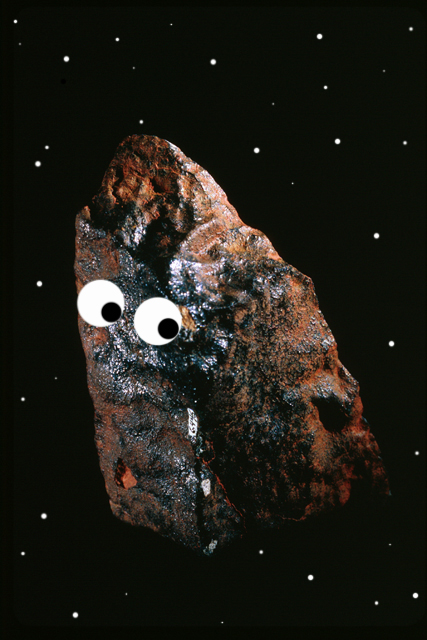
Okay, the last one wasn't wrong, but I just had a mental image of a lurking meteor(ite), and it looked something like this:


Watch out, folks. Those space rocks will get you.

Sunday, March 7, 2010

Close to home: The 2010 Ed Roy Award

Some great news from Geospectrum - the latest Ed Roy Award winner is Jason Pittman, the lead science resource teacher at Hollin Meadows Elementary School in Alexandria, VA. This has me completely excited, because Hollin Meadows was the first elementary school I attended, and it's literally steps from home. It's a math and science focus school, and it's one of the first places I started getting excited about geology. (I even remember drawing volcanoes on one morning journal exercise...)

The Hollin Meadows website has a great section devoted to their science lab, and I'm sure Mr. Pittman had a hand in it, since he's also a top web designer. Have a look!

Here's a little about the award from AGI:
Given annually, the Edward C. Roy, Jr. Award recognizes one classroom teacher from kindergarten to eighth grade for his or her leadership and innovation in earth science education. This award is named in honor of Dr. Edward C. Roy, Jr., who was a strong and dedicated supporter of earth science education. Mr. Pittman will be presented with the Edward C. Roy, Jr. Award at the 2010 National Science Teachers Association National Conference in Philadelphia, Pennsylvania. Other finalists for the 2010 award are Greer Lynn Harvell of Clifford C. Meigs Middle School in Fort Walton Beach, Florida, and John Schaefers of Ingomar Middle School in Pittsburgh, Pennsylvania.
They haven't updated the main part of their website yet, but the Ed Roy award page has some more info about applying, as well as past winners. If you know anyone who teaches K-12 earth science and you think they're doing a stellar job, I encourage you to get them to apply for this - it's a great opportunity for recognition!

Everyone at Hollin Meadows must be really proud of Mr. Pittman - and I am, too, even though I only have a very loose connection to the school now. It's been a good few months for them - they also hosted the First Lady in November, and had a chance to show off some of the extensive flower and vegetable gardens that make up an important part of their science program. Congrats to Mr. Pittman and Hollin Meadows!

Friday, February 5, 2010

Blast from the past

On Wednesday the volcanology lab groups here at UB had a discussion about basaltic eruptions, particularly at Paricutin and Jorullo volcanoes in Mexico. The first thing I was reminded of on hearing the name Paricutin was not a geological fact, but a childhood memory - one of watching Reading Rainbow, actually.


Reading Rainbow, if you aren't familiar with it, was one of the best children's shows out there. Sadly, it ended in 2006, but in its 23 year run, host Levar Burton and any number of celebrity narrators did wonders to keep kids reading and show them that books were not only worth their time, but fun and exciting to boot. Each episode was divided between book reviews and readings - sometimes by well-known celebrities like Julia Child and James Earl Jones, to name a couple - and Levar Burton visiting people and places related to the theme of the episode. It was one show that my parents were happy to let me watch any time it was on, and they'd usually try and find the books for me to read afterward. It's sad that it's no longer going, but hopefully reruns will still pop up on public television stations.


In fact, a few of those early episodes - reruns for me, since I wasn't around to watch their first runs - were responsible for starting me on a geologic path. I particularly remember one episode called Hill of Fire, in which the featured book talked about a volcano that suddenly appeared in a Mexican cornfield - Paricutin, of course. I thought this was totally fascinating, and probably asked my parents if we could have a volcano in our backyard, or something like that. And now that I'm in graduate school, I can look back on what I remember of that show and use it as a basic context for understanding the professional papers I'm reading. How cool is that?
Another episode talked about one of my favorite childrens' book series: The Magic Schoolbus. Who doesn't love Ms. Frizzle and her crazy bus? Of course, the book was The Magic School Bus Inside the Earth, which I'm sure I made my mother go out and buy for me right afterward. These books were a great introduction to science topics, because they gave you the facts as a part of a narrative. Sneaky! Plus it's always fun to see what clothing Ms. Frizzle is going to wear next. Personally, I want some of those jumpsuits for when I do fieldwork.


Not to mention Three Days On a River In a Red Canoe. It's not about geology, but it was my first intro to camping. I didn't do any serious camping until I was in college, but this episode definitely had me out in the backyard for a few nights that summer. I have yet to take a canoe trip, however...perhaps a goal for this summer?


Obviously, these aren't the only geology/outdoors-related children's books out there, but they are a few of my favorites - and I remember them after fifteen years or so because of Reading Rainbow. 

Sunday, July 5, 2009

A geology geek to the core (Accretionary Wedge #18)

Sitting here in Zion National Park, one of the last spots I visited on my first geology field course, I feel like I'm coming full circle to some of the reasons that I'm still doing geology. (I also feel like I could receive wifi through my teeth. Twenty plus wifi points? Really?) Anyway, it's a perfect chance for me to answer Volcanista's question:
So July’s topic is about your inspiration to enter geosciences. Was it a fantastic mentor? Watching your geologist parents growing up? A great teacher, or an exciting intro field trip? How did it happen?
I first became interested in geology as a little kid - that rock and dinosaur phase that so many of us go through. Fortunately, living in the DC area meant that I could go see the Smithsonian Natural History Museum pretty much any time I wanted to, and I did. I remember my dad lifting me up over the rail so I could pet the fake tyrannosaur skull, and driving the video camera that looked in on the fossil prep lab, and peering at the fluorescent minerals in the gem and mineral exhibit. My parents let me dig giant holes in the backyard, and the one time I found a fossil (a shell mold), I remember asking if the Smithsonian might want it for their collection.

I pretty much knew I wanted to do geology all through primary and secondary school, and especially volcanology. Some Saturdays I would watch tapes of the old Planet Earth series (the one narrated by an Attenborough, not this Sigourney Weaver stuff they redid recently), and I would always skip to the plate tectonics and volcanoes episode. (Yes, I was pretty much an uber-geek from the start.) When I got to high school, the "geosystems" class was mostly meant for non-AP-track students, so I took AP Chemistry and, somehow, found out about a volunteer position at the Smithsonian instead, helping edit the Bulletin of the Global Volcanism Network . Two summers of that and I was hooked on volcanoes for good; I literally couldn't imagine having any career other than geology, and volcanoes were especially fascinating.

When I went looking at colleges, the geology program was a big factor, and I pretty much knew that I was going to go to William & Mary the moment I set foot on campus. When I started classes, I was so excited to be taking intro geology that I sat front and center the whole semester (although the instructor, who was a visiting prof, didn't even recognize me when I met him at GSA a year or so later). I was lucky enough that my freshman advisor turned into my permanent advisor, and that he took a chance on letting me into his Regional Field Geology course with nothing more than Intro and Historical Geology under my belt.

And that's how I ended up in Zion, and a lot of other places on and around the Colorado Plateau, after my freshman year. I didn't know much about minerals, or field mapping, or structures, or petrology, or pretty much anything at the start of that trip - but boy, did I learn. After three and a half weeks in the field I was pretty much hooked for life, even though I spent a good chunk of it being sweaty and tired and sleeping on rocks and generally being upset with my own lack of experience.

I was also hooked on the field work, which turned out to be a good thing - my senior research project, and some mapping I've been helping with the last couple of years, grew out of one stop on that first long field course. My advisor played a huge part (and I've written about it before), and the fact that he pushed me to work hard and take risks is one of the reasons I'm still in the field. It's invaluable to have someone who believes in you, after all. (He's also one of the reasons I became a better writer, and boy, has that paid off!)

I think the moment that I knew without a doubt that I wanted to be a volcanologist was when I scooped a blob of molten rock out of a Kilauea lava flow and watched it cool. My field notes for that hike say "BEST DAY EVER!" even though I know I was tired and hot and had a twisted ankle at the end of the hike. Handling the lava - seeing it up close for the first time - was just addictive, and every time I see a volcano I get the same sort of rush, to varying degrees.

So, I guess my answer is a mixture of things. I feel like to some extent the geology just got hardwired in there, although I have no idea how. But experiences and mentors were a huge part of it as well - and now that I'm in grad school for volcanology, and have even more great mentors to work with, I hope I'll want to stick with it for a long time to come.

Wednesday, January 28, 2009

Best labs for introductory geology courses?

My department will be restructuring some of their introductory geology labs soon, and I was asked my opinion of the labs that I taught last semester. I was pretty brutal about some of them: they were difficult both to teach and to get the students to understand. When you're spending most of your time apologizing for the shortcomings of a flow chart that the students are supposed to be using to identify minerals, for example, neither you nor the students are getting much out of the lesson.

There were a number of other issues with the labs, but one of the big questions about the intro labs in general was what were the most valuable labs for different categories of student. The way our courses are likely to be restructured, we may end up with one general geo course and lab for the fall semester, and then two - one for geology majors and one geared more for environmental majors and non-geo-majors - in the spring.

So if you're going to split up classes that way, how do you create a set of labs that both hooks the potential majors but doesn't overwhelm the people who are just in the class for a science requirement? How do you make sure the majors are getting instruction in essential, basic skills, but still teach the non-majors something they find interesting and useful? To make things more complicated, how do you do this in a lab that, because of the 300+ person class size, meets every other week - meaning you only have six or seven labs to do this in?

My undergraduate intro geology lab followed this progression:
  • Mineral identification
  • Rock identification, rock types and the rock cycle
  • Structural features of sedimentary rocks (including mapping on aerial photographs, geologic map interpretation, and geologic cross sections)
  • Plate tectonics
  • Geologic interpretation of topo maps, aerial photos, and satellite images (emphasis on fluvial features)
  • Ocean and coastal processes
Looking back on it, it's both a little scattered and very heavy on what I tend to associate with geology rather than geography or environmental science - rocks and minerals, structure and tectonics, mapping. I remember finding the rock and mineral and mapping labs very useful, but I knew that I wanted to major in geology, and wanted to learn as much as possible as fast as possible.

The lab that I taught last semester went a little differently:
  • Rock descriptions (really basic stuff, not requiring mineral or rock IDs)
  • Mineral identification
  • Sedimentary rock identification
  • Impact cratering
  • Streamflow processes (with stream table)
  • Stratigraphic columns, topo maps and geologic cross sections
  • Folding and faulting
This set of labs reflects some of the research preferences in our department, planetary geoscience and Western NY geology (including the evolution of Niagara Falls and the Niagara Gorge).

I feel like there are pros and cons to each of the sets, but my viewpoint isn't necessarily what's going to be good for a nonmajor who needs a science requirement. And whether or not that nonmajor goes on in geology, it's important for them to get something useful out of the class.

So, how to compromise? It's a tough process. I'm not the one who gets to make the final decisions, but I think that there are some basic concepts that an intro lab should cover:
  1. Minerals. This is the basis of geology - if you don't know the minerals, you don't know the building blocks of the Earth. Everyone coming out of an intro lab should be able to recognize quartz and calcite, as one of the professors here said.
  2. Rock cycle and types. This is a chance to introduce both the rock types and the processes that create them, as well as a few basic rock names in each type. Students can then take this knowledge on to a petrology class (usually taught for igneous and metamorphic rocks, I've found) and a sedimentology/stratigraphy class (for the sed rocks).
  3. Surface processes. Weathering and erosion, as well as fluvial features could be included here. I found that my students had very little concept of how sediment was formed, transported, and turned into rocks. The lab that we did with the stream table helped fix some of that, and it was their favorite one; they were the most engaged and spent the most time thinking about what they were observing. This also would have been a fun one to do outside, but it was too cold by the time we got to it.
  4. Atmosphere and weather. I can think of a lot of people who watch the weather forecast every night without having the faintest idea how it's put together, or the difference between weather and climate, or (for example) why it snows a lot south of Buffalo but not so much north of the city. (This is not the case today, however.) Having a basic knowledge of the structure of the atmosphere and how certain types of weather and climates come about is important for life - you've got to deal with weather every day, after all.
  5. The solar system/geology on other planets. With all the great research going on these days into formation and evolution of other planets in the solar system, it would be a shame to skip planetary geology in an intro course. (It's also a good opportunity to chuck things at sandboxes, which seems to have gone over fairly well in this week's labs.)
  6. Maps. Absolutely NO ONE should leave a geology or environmental science course without knowing how a map is put together and how to read it. In the age of GPS navigation and Mapquest, it's honestly shocking how many students I encounter that can't deal with a paper map. Including topographic and geologic maps in this section would be good too, especially for majors, but also as a way of exposing students to something other than a talking car computer or a fold-out road map. (This would also be a great chance to integrate Geocaching into a lesson and get the students outside.)
  7. Natural hazards/disasters. This would be a favorite of mine just for the chance to talk about volcanoes, but it's a chance to separate students from what they hear on the news (which is often wrong) and explain what's really happening when, say, a hundred-year flood occurs, or why an earthquake will or won't create a tsunami (and what to do if you're in danger of getting hit by one). It's also exciting stuff, which is always important if you're trying to hook people on a major.
Just a few thoughts on what I'd find useful as a beginning geology student, really. I'm sure that the basics would vary depending on the department and who's qualified to teach certain subjects.

So what would you all, who collectively have much more experience with this sort of thing, want to see in an introductory lab? At some point I might get asked to help decide this for my current department, so your input is greatly appreciated!
Friday, January 9, 2009

Geology and the movies again...or "Why Disney's Pocahontas Briefly Makes Me Want To Scream At The TV"

This is actually an older post I've been sitting on, but I wanted to get something posted this week, even if it's not about current events.

I love watching Disney movies, but occasionally the scientist gets in the way of the nostalgic enjoyment. I was reminded of this when "The Virginia Company" came up on my music player's shuffle list. Pocahontas, which came out in 1995, is set in an area that I'm now very familiar with (the Historic Triangle, home of Yorktown, Williamsburg and Jamestown). It's also on the Coastal Plain, which William & Mary's Geology Department is very favorably situated to study. In fact, unless you drive west for an hour or so, all you see in that part of Virginia is Coastal Plain. Aside from the cool fossils and some of the sedimentary features (and a big honking impact crater, although you can't see it) the Coastal Plain has relatively little to interest a volcano nut - I had to go out to Richmond to see any hard rock aside from river cobbles.

From the Geology of Virginia Website at W&M (click to view the bigger version).

That doesn't mean I didn't pay attention to the Coastal Plain geology. I did - and that's why seeing the beautiful landscapes that show up during John Smith's bold adventuresomeness in the "Mine, Mine, Mine" sequence irritates me enough that I want to smack the animators.


Where the hell did that mountain come from? (For that matter, why is it magically spouting a waterfall?) Did any of those animators actually go to Jamestown? Or look at a photo? Or a map? Jamestown is pretty much in a swamp, which was a really poor choice to begin with (one might assume that the colonists weren't thinking about the scenic needs of future moviemakers when they landed there). There are no mountains, no waterfalls, and NO CLIFFS there...

...unless you count the crumbly sandy ones along the rivers.

See? Not impressive*. What is impressive is that John Smith apparently had the ability to teleport himself to the Piedmont in the course of the musical number, because you ain't getting those rolling hills in Eastern Virginia. And the scene where Pocahontas jumps over a waterfall from a tall rocky cliff means that she managed to teleport all the way out to the Blue Ridge, because you don't get waterfalls without bedrock, and the Coastal Plain doesn't have it.

The one thing that the movie does get right about the geology is that you'd have a hard time finding any gold on the Coastal Plain. In other parts of Virginia, certainly, but on the Coastal Plain, you sometimes have trouble just finding dirt, much less gold. (There is a LOT of sand out there, however.)

I'll ignore all the film's other inconsistencies here - screwing up all the Native American names, and the whole John Smith/Pocahontas thing, which didn't really happen - since other people have ripped into them much more eloquently than I could. Let's just say that while the Disney crew might have had good intentions, they managed to both insult Virginia's current Native Americans and perpetuated a beloved but totally inaccurate American myth. AND annoy the geologists.

I'm not saying that the more historically accurate movies are much better, mind you. The New World, which actually was filmed near Jamestown (the movie people hung out in Williamsburg when they weren't filming, which the W&M crowd thought was pretty cool), is a mind-numbing artsy-fartsy epic that drags on until you find yourself wanting to join the colonists who are croaking from malnutrition. It does get the utter stupidity of trying to found a colony on swampland that the natives obviously aren't even bothering with, as well as the oppressive heat and humidity and clouds of biting insects right, but in this case accuracy doesn't make for entertaining cinema. (And those actors really were out in an Eastern Virginia summer, which makes me feel really sorry for the ones who had to wear wool. I spent one summer in Williamsburg and immediately vowed never to do so again, because I like to breathe air rather than soup.)

In the end, I do realize that Pocahontas is a cartoon, and Disney, and geologic accuracy was not a major concern of the movie. But I do feel like the animators cut some corners and went for flashy rather than putting in the effort to reproduce what the Jamestown colonists might really have seen when they arrived in what would eventually become Virginia. For a movie that was otherwise beautifully animated, that was a real disappointment.

And I cannot forgive the cliffs. :)

*In fact, we reduced what little impressiveness they have by initiating multiple mass wasting events just by digging.

Thursday, January 1, 2009

Go for the art, stay for the volcanoes

Happy New Year! Here's to a successful, productive, safe, and above all fun new year. I've recently noticed that I've been added to a list of the 100 Best Blogs for Earth Science Scholars, which is quite an honor, and especially since I'm in such great company. Seems like a good way to start off the year to me!

A few days ago I went to Washington DC to get my bi-yearly fix of the museums, which (for me) generally means drooling over the volcanic rock displays in the Natural History museum and scarfing down gelato in the in the cafe between the National Gallery buildings. (I also saw the newly-renovated American History museum, which was somewhat unimpressive, and the new Ocean Hall at NMNH, which was awesome. Callan's review pretty much covers everything I could come up with to say.)

My favorite stop of the day, however, was in the East Building of the National Gallery. They're currently hosting an exhibition about pre- and post-eruption Pompeii called
Pompeii and the Roman Villa: Art and Culture around the Bay of Naples. Most of the exhibit is devoted to the way that wealthy Romans decorated their homes, and how they liked to copy and emulate Greek art, and it's really neat; the frescoes are especially beautiful, and the statuary, while probably not something I'd want in my own home, is incredibly lifelike and masterfully done. (It's also very cool to look Julius Caesar in the eye, because you get a sense of who the man was rather than the legend.) Unfortunately, there was no photography of any kind allowed in the exhibition, so I can't show you what was on display. There is a pretty neat video about the exhibition on the NGA website, though.

The most exciting part of the exhibit, in my opinion, wasn't the sculpture or the frescoes, but the room that showed 18th-century romanticizing of the 79 A.D. eruption. Why? Because it had these paintings on display:

Pierre-Jacques Volaire, The Eruption of Mt. Vesuvius, 1777; from the North Carolina Museum of Art

Joseph Wright of Derby, Vesuvius from Portici, 1774-1776; from the Huntington Library, California

And a copy of this book:


For a volcanologist, you can't beat that. I got a few funny looks when I was explaining to my dad why I was so excited about seeing this part of the exhibition, but there were a few smiles in there too. And it isn't every day you get to see such beautiful work that also reflects some of the earliest beginnings of the science of volcanology.

The exhibit will be at the National Gallery until March 22, so if you have a chance to stop by, I would definitely recommend it. (Even though the NGA isn't part of the Smithsonian system, it's still free, so it's affordable even for a poor grad student like me. Unless you give into the temptation of the gelato bar, that is.)

Monday, October 13, 2008

Happy Earth Science Week!

I'm a day late, but only because I was visiting Niagara Falls yesterday with my dad - and if that doesn't fit with this year's theme ("No Child Left Inside"), I don't know what does. See the Earth science? See it?


Earth Science Week is a yearly outreach campaign run by the American Geological Institute (the people who publish Geotimes-now-Earth-Magazine, run GeoRef, and represent more than 44 other geoscience organizations in various capacities. ESW has been going for more than a decade, and it's a great opportunity for anyone to get involved in the Earth sciences. This year's theme, "No Child Left Inside" reflects the efforts of a coalition formed to help alleviate "nature deficit disorder" (another way of saying "our kids don't know squat about the outdoors and they spend all their time parked in front of electronic gizmos, which is not making them healthy"). There are nationwide events going on, many of them held by state geological surveys and science museums (some of which are shown on a Google map on the ESW website). Not to mention the contests, which are open for entries until this Friday - there are TWO photo contests this year, by the way, and the prizes include a little cash and a copy of AGI's Faces of Earth DVD.

You can also order a toolkit, which is packed with awesome posters and DVDs and CDs (even a 3D comic book "science fact/fiction" guide to Journey to the Center of the Earth 3D, which came out this summer); download a calendar; see which states have issued proclamations about ESW; look up Earth science career resources, scholarships and internships; find information on planning your own event; and get your event featured in the ESW photo gallery. (Oh yeah, and a Facebook Group and Newsletter. Everyone should sign up for the newsletter - you'll find out about the contests way ahead of time, as well as other useful geonews.)

Advocating Earth science is really important right now, especially considering that it's an election year (and not just on the national level). There are a number of states where Earth sciences are being cut from the curriculum entirely, because someone in charge of the pursestrings has got it into their head that the geosciences aren't "real" science, and therefore not important. It's totally appalling, and one reason that I keep blogging - I don't want to waste any opportunity to tell people that Earth science is really, REALLY important. AGI actually has an advocacy guide up on their "Pulse of Earth Science" webpage, along with pages that list the current Earth science curriculum standards in each state.

A few other bloggers have also put in mentions about ESW, and if we all do, we'll be making a big difference. If nothing else, you can have fun greeting everyone this week with a cheerful "Happy Earth Science Week!" - and maybe some of them will join in!

Wednesday, September 10, 2008

Close encounters

A few days ago, in the process of selling some unwanted furniture (Craigslist is my new best friend), I found myself in an interesting situation. The gentleman who came to buy my chair and I were making polite conversation; he noticed that I had an out-of-state license plate on my car and I told him that I'd moved here for graduate school. He asked what I was studying, and I told him geology - specifically volcanology - and then gave him the short version of why I think erupting volcanoes are awesome.

He paused. Then, in a slightly different tone of voice, he said, "There's something I'd like to give to you." After digging around in a bag for a moment, he turned around and handed me a paper booklet. "I'm sure that as a geologist, you've come up against a lot of different ideas about creation and the world," he went on, and I could feel my face freezing into a rictus smile. "This is just a Gospel tract for you to read and think over."

To my immense relief, he didn't go any further than that, and I was able to thank him politely, tell him I hoped he enjoyed the chair, and go back inside. The booklet, as I expected, was heavily emblazoned with patriotic imagery (a really angry looking eagle plastered on top of the American flag), and filled with a bunch of gloom-and-doom Bible quotes about sin and some really poor-quality comics (Jack Chick tracts, anyone?). I relegated it to the recycling pile, and then got to thinking about the whole experience.

This actually isn't the first time I've encountered that kind of a response as a geologist. Once was on my first long field trip, where an elderly lady cornered the professor in a grocery store parking lot and wanted to know if we were looking at rocks formed in "The Flood", which she assured us were very common in the area (somewhere in Utah, I think). The second time was during a "Geology Day" that our department held every year; one of the seniors was running a demonstration about dinosaur bones, and became very upset when two young children began berating her about the ages of the bones and insisting that the Earth couldn't be older than 6,000 years. (The other senior in the room actually had to leave for a few minutes to keep herself from attempting to strangle said small children, that sort of thing being frowned upon in community events.)

In the first instance, as I remember, my professor made some vague comments about the rocks probably having been deposited in water, and made his escape. In the second case, the senior had to stop her discussion and ask that the children be considerate of everyone else and wait until she was finished to get into an argument with her (which they may have done, although I wasn't there).

What is it about geologists that makes some people want to convince us of the validity of their worldview, as opposed to practicing tolerance and acceptance of others? The man I encountered was polite, and didn't go farther than handing over the pamphlet, but he was still making assumptions about me - and he had no way of knowing whether they were true. (I have, in fact, taken and enjoyed a number of classes about world religions, and they did cover different creation stories. I was also raised with a theistic worldview, although it's been modified somewhat as I've aged, and been better able to examine my religion and my feelings about it.)

I think what offends me the most is the assumption that because I'm a scientist, I must automatically need saving, pulling back into some sort of protective cloud of religion which is the only safe haven of morality and virtue. I have no problem reconciling my religious beliefs and my profession, and I don't believe that it makes me an immoral or unkind or a bad influence on impressionable young people. Not all scientists are atheists, and being an atheist doesn't automatically make you lose all sense of morality.

Another thing that I found distasteful about the encounter was that to me, religion is a very private thing, in contrast to being a scientist (which I'm happy to proclaim loudly to the world at every opportunity). I'm happy with my religious viewpoints; whatever works for other people is fine with me - as long as it doesn't involve trying to change my beliefs. I realize that a major part of some religions, especially evangelical Christianity, is proselytizing, and that these people genuinely feel that they're helping me. Not to be rude, but here's a news flash:

You are not going to convince me that your system of belief, or worldview, or whatever, is better than mine by telling me that I'm wrong. You might get me thinking about it by demonstrating through the way you behave toward others that it's a good idea, but it's not likely. And you certainly aren't going to make a good impression on me by treating me like a misguided child.

In the meantime, I'm going to go on being fascinated and amazed and awed by the concept of deep time, and the Earth and the universe being billions of years old, and how cool it is that life could have evolved from a few teeny little cells way back when. And I'm sure I'll come up against this question of conflict between religion and science again, whether in conversation or in class, and I'll handle it the best way I know. And hopefully, someday, some people will stop thinking that I'm a godless heathen just because I like to play with rocks.

(Wow, that was rambling and philosophical. I've definitely got to finish up some of my literature review for this thesis thing so I can start writing about volcanoes again soon.)

Sunday, August 24, 2008

Accretionary Wedge #12: Geology as a connector science

Hooray! I finally have both a working computer and internet connection. Definite cause for celebration, since I can now get back to blogging - at least as much as grad school allows, that is.

Even more cause for celebration: This is post #100! I think it's fitting that it should be an Accretionary Wedge entry, since at least part of the reason I started blogging was to connect with other people in the "geoblogosphere" - and what better way to do that than an online panel discussion? (Hey, there's that connection theme again.)

I've decided to write about something that's going to happen in a few days: I'm going to stand in front of an introductory geology lab and try to convince myself that I'm qualified to be teaching people who are only a few years younger than me. I expect that many of them will be freshmen, or non-science majors, who are in the class because they have to fulfill a science requirement. My undergrad classmates called this the "Rocks for Jocks" phenomenon, and we always laughed gleefully afterward, because we knew that anyone who picked geology because it was a "soft" science would be very surprised when they got to class. This phenomenon is also, in my opinion, at the root of the difficulties that science educators have keeping geology in science curricula at the K12 level. We as geologists all know that geology is one of the most inclusive sciences there is - but how do we get this across?

One of my main concerns is to make my labs not only fun for my students, but relevant to their lives. They're probably used to thinking of sciences as compartmentalized - this is chemistry, this is physics, this is astronomy, etc. I want to prove to them that not only is this untrue, but that they've probably used or relied on geology - and all the other sciences it incorporates - on a daily basis.

I'm planning on doing a short activity based on one that my mineralogy professor did early on in his course. I'll be handing out Oreos (knowing full well that food is an excellent tool for bribery), then asking the students to think about what goes into them (and the packaging). Once we've got a list, I'm going to ask them to tell me where each ingredient comes from, and how it is obtained. This is a great place to bring geology - and other sciences - into the discussion. Cocoa, for example, is commonly grown in tropical climates, and in rich volcanic soils (like in Central America). That chocolate flavor came (ultimately) from a volcano! The white filling is colored with TiO2, otherwise known as rutile, which can also be found in quartz crystals. There are minerals in that cookie! The plastic wrapper and tray are made from chemicals derived from petroleum products, which started as rotting leaves in a coal swamp teeny dead ocean critters hundreds of millions of years ago! And so on.

The value in the activity - aside from the brief boost in attention span resulting from sugar intake - is that they see the connections that science, and geology in particular, have to their everyday lives. Geology isn't just something that grubby, bespectacled rockhounds do off in the mountains somewhere; it's something that ultimately helps produce the food we eat, the packaging that keeps it fresh, the fuel for transporting it, the nuclear energy that runs the lights in the grocery store, and more.

Hopefully, in trying to communicate how geology is intimately connected to our lives, I'll also be able to get across how important it is to me, and how exciting I find it because of all those wonderful connections. And, according to the people in my three-day "how to not fail as a teacher" training session, getting your students excited about learning is the most important part of the job.

And there are some thoughts on connections, with a bit of wandering thrown in. (And after what I've gone through to get moved into a new apartment in a new state and trying not to panic about teaching and taking classes, I think I'm allowed a few tangents!)

Monday, July 14, 2008

Earth: The Biography - Impressive footage, but lacking in substance

Last night I watched an episode of the BBC's new series Earth: The Biography, which is currently showing on the National Geographic Channel. The series has 5 episodes - "Atmosphere," "Ocecans," "Ice," "Volcanoes," and "Rare Planet" - and is hosted by Dr. Iain Stewart of the Science Channel's Hot Rocks. It's been pretty heavily promoted by NG, and since it's a BBC production I'm assuming it's showing on their science channel as well (neither of which is very helpful to people who don't have expanded cable or satellite, though). The BBC News announcement from last year is here; their blurb says that
"The new series will highlight the delicate balance of life on the planet and how its history has lurched between disaster and recovery."
I watched the "Volcanoes" episode, which is described on the National Geographic website as follows:
"Volcanoes are one of nature’s most awesome and destructive forces, but they are also the life force and architect of our planet. They can raise up great mountains and create new land, or they can level cities and destroy entire civilizations. They provide a glimpse of the power of Earth’s internal heat source, without which it would have become a dead planet millions of years ago. In this episode, Iain takes us on a journey to some of the most dramatic places on Earth, starting in Ethiopia."
I was hoping for another good addition to what seems like a recent trend in popular science programs featuring geology or environmental science, and I had pretty high standards, since the BBC is one of the few media outlets that still thinks science is newsworthy. What I found was that while some things about the show impressed me, there were a number of things going on that I didn't like at all.

On the plus side, "Volcanoes" featured some really spectacular photography. The episode begins on the slopes of the Erta Ale volcano in Ethiopia, which is the site of a famously long-lived active lava lake (it's been around since at least 1967). Dr. Stewart does what any good crazy geologist would do - rappels over the edge of the outer crater and makes his way as close to the inner crater edge as possible, where we (somehow) get so see some wonderful "flyover" shots of the lava lake. The footage is really beautiful, although I hope the cameraperson had a really long telephoto lens for some of those shots. The rest of the episode is equally well-filmed, with a number of great aerial and satellite images as well as very good groundwork (my personal favorite being a shot of an erupting Icelanding geyser that's perfectly lined up with the sun overhead).

The show makes a pretty dizzying series of jumps to different places around the world - Ethiopia, Iceland, Pakistan, New Zealand, South Australia - but shows off a number of geologic locales that don't usually get a lot of visibility. I was pleasantly surprised to see Shark Bay in Western Australia featured in the discussion about volcanoes and the early Earth, and Thingvellir in Iceland in a segment about mid-ocean ridges. The field trip Dr. Stewart took to a South Australia outcrop containing Ediacaran fossils was very neat, especially the clever use of Silly Putty to make the fossils more visible without damaging them.

While the views and localities are definitely worth seeing, the narration is very light on science. Dr. Stewart discusses the basic ideas behind plate tectonics and convection, and is (thankfully) very careful to say "hot rock" instead of molten rock, but then the focus skips away from volcanoes and settles on tectonic mountain-building processes. For several minutes we hear about how mountains are built through collision tectonics and then eroded by weather and water, but there is absolutely no tie-in of volcanoes - indeed, there are several opportunities for discussing how "subduction volcanoes" build mountains that are completely passed over in favor of flyovers of the European Alps and (I believe) the Southern Alps in New Zealand.

Another disappointing aspect of the show is that there are very few interviews with specialists. While Dr. Stewart is certainly a qualified geoscientist himself (he currently lectures at the University of Plymouth, and he's been a lecturer at Brunel University and the West London Institute of Higher Education in the past), his narration is very broad and shallow. Two interviews are presented in the course of the hour - neither with a volcanologist - and while one does touch on the role of volcanoes in fostering life in geothermal springs and undersea vents, the other interview is with an expert on the Cambrian explosion, and concerns fossils. Granted, the show's focus is on the interaction between life and geology, but it's a little strange that the producers chose not to avail themselves of all the volcanological experts out there for an episode on volcanology. (They didn't even bring out Don Swanson, who's practically a fixture for popular science programs on volcanoes.)

I was equally unimpressed by the animations. I've been watching programs like this for a long time (all the way back to reruns of the PBS Planet Earth series that came out in 1986), and the animations in this one were pretty underwhelming. They were overly-simplified and, if Dr. Stewart hadn't been so careful to note the difference between hot rock and magma, could have been misleading. I much prefer the ones that appear in the recent Faces of Earth series, which also gets my vote for better science content and interviews. (Faces of Earth occasionally runs on the Science Channel, but can be purchased through the American Geological Institute
or the Discovery Channel store.)

I found the attempt to link geology and the evolution of life a bit confusing, and frankly clumsy. There was a little too much discussion about how "amazing" it was that volcanoes and life were "able to fine-tune" atmospheric CO2 levels, for example. While it's true that there is a global cycle involved (CO2 is emitted by volcanoes, trapped by biota, captured in ocean sediments and then returned to volcanoes by subduction), it's misleading to describe the process as if there was any active intelligence involved on the part of the volcanoes or the plankton. In reality, the biologic elements adapted to the conditions created by the volcanoes; much as we like to anthropomorphize things, it's simply not appropriate for a geological discussion. The portion of the episode where hot springs and geothermal vents are pointed out as the probable locations for the origins of life does actually come up at a logical point, but some of the other instances where life and geology are linked seem slapped-on, like the producers couldn't decide what kind of focus the show was supposed to have. It made for a very disjointed progression, without a good flow of ideas and easy-to-understand linkages between concepts.

Ultimately I would recommend the series for its cinematography, which was excellent, but I was let down by expectations that it would be a more in-depth version of the Hot Rocks show. Even for a casual audience, the science was sparse and terse, thrown out in little tidbits that seemed more like photo captions than anything else. And while it's certainly fun to listen to Dr. Stewart (since he is an engaging speaker, and I think he has a neat accent), and I'm sure he had a great time getting to visit all the beautiful locales, it doesn't make up for the fact that there's more geological eye candy than content in the epsiode I watched.

Thursday, May 15, 2008

Because Earth science does way more than rock

Here's a good resource for anyone who's introducing students to Earth science, trying to keep it in or add it to a curriculum, or anyone who wants to see really cool animations. It's AGI's "Why Earth Science" video, which they've recently posted on the web.


There's also an accompanying brochure available for downloading in English and Spanish versions.

Monday, January 7, 2008

Where on (Google) Earth #86

Excitement! After solving my first WoGE (#85, a river in southern Turkey), I've been accorded the honor of hosting the next installment.

Ladies and gentlemen (and others - because I know at least a few geologists who definitely don't fit those categories), for your viewing pleasure:


The view is oblique to the North at about 4 km altitude; because it may turn out to be pretty easy for some people, I'll invoke the Schott Rule. For anyone (like me!) who's new to the game, identify the location of the feature (place name and/or lat and long), and take a swing at what's happening geology-wise. Have fun! (Posted at 7:50 PM Eastern time.)

Saturday, December 22, 2007

A journey of a thousand miles...

I've been contemplating, for some time, starting a blog about my experiences as a female geologist (and continuing geology student). I've recently discovered a number of other geology and science-related blogs, and I find their discourse stimulating, informative, and in many cases enlightening. It's useful to me as a student to have insight into the thoughts of professors and older scientists, and it's often easier to discover it through print than conversation, since my interactions are usually limited to my undergraduate department, conferences or the occasional research collaboration. All of these are useful, but I feel like there's very little discourse among students about what it's like to be in the formative years of your career.

FemaleScienceProfessor's blog is one of the most interesting to me, since she describes not only the internal workings of an academic science department but the experiences she's had as a woman and a scientist. I've been lucky so far to never encounter the kind of chauvenism and callousness she's had to deal with, and perhaps that's a result of my choice of geology for a field of study. She's never really specified what field she works in, and I don't want to try and guess because I'd rather not start out with any preconceived notions of what I might be getting myself into. I hope that I'll be fortunate enough to avoid those difficulties, though I'm not so naiive that I believe that will never be the case.

At any rate, I'm currently working (quite happily) for a non-profit geoscience organization where I get to help promote geology, but I'm very eager to continue my studies in graduate school, and to that end I'm deep in the throes of graduate school applications. I'm finding that I alternate between enthusiasm for the prospect of starting the next phase of my career, and total disgust for the amount of crap I have to deal with just to complete an application. Every time I turn around there's another form that has to be signed, letter to be requested, essay to write, or transcript request to pay for and send in.

The transcript requests are what really annoy me. Out of three schools and the GREs that I have to get transcripts or scores from, only ONE school doesn't charge for a transcript request - and that's the community college! I understand that these institutions need money to operate, but isn't the money that I paid to TAKE these classes in the first place enough to cover postage and the cost of a few pieces of paper with official stamps? The GREs are especially galling. I only had to pay more than a hundred dollars to take the damned test in the first place - on ridiculously outdated computers, no less - and it costs me another $15 every time I need a copy of the scores. Ridiculous. They're MY scores; I earned them. I paid to take the classes and the test. It strikes me as slightly petty to charge students an additional fee simply to have access to something that rightfully belongs to them.

Anyway, the application slogging continues; I hope to be done with them before the New Year rolls around. Two down and four to go - thank goodness that all of them are online, at least partially. (And I have to wonder who gets the processing fee that goes along with some - though not all - of the applications. If it's being used to pay for printing all the paperwork I'm submitting, and to pay the salaries of the people who have to process and file it, then I suppose it's appropriate that I get charged. I won't begrudge them that.)

Then, I suppose, the waiting game begins. I was lucky enough as an undergraduate to be accepted early admission to my college of choice, so I didn't have to complete multiple applications and agonize about which ones were going to result in acceptance letters. I guess it's my time to give up the blood and sweat I didn't pay out the last time.

Wish me luck, blogosphere!