Showing posts with label movies. Show all posts

Saturday, October 30, 2010

Geological Frightfest: The Monolith Monsters


Lee Allison at Arizona Geology deserves credit for inspiring the last movie in the Frightfest series - in his post from June about the Piranha 3D movie, he also mentioned The Monolith Monsters. Again, it's another 1950s movie I haven't had the chance to see, but I'll definitely have to remedy that if I can...guess what's next on the Netflix queue? With a title like that, though, I couldn't resist looking it up. And boy, this one is a doozy. Here's the IMDB summary:
A strange black meteor crashes near the town of San Angelo and litters the countryside with fragments. When a storm exposes these fragments to water, they grow into skyscraper-sized monoliths which then topple and shatter into thousands of pieces that grow into monoliths themselves and repeat the process. Any humans in the way are crushed or turned into human statues. The citizens of San Angelo desperately try to save themselves and the world from the spreading doom.
Wikipedia also expands on this with some dirt on some of the main characters, who happen to be geologists (though apparently not very good at on-the-fly rock identification):
In the desert region of San Angelo, California, geologist Ben Gilbert brings a strange black rock back to his office, where he and bored local reporter Martin Cochrane examine it but fail to determine its origin. That night, a strong wind blows a bottle of water over onto the rock, which begins to bubble and smolder. The next day, the head of the geological office, Dave Miller, returns to town from a business trip and finds the office destroyed by a huge growth of black rock and Ben dead, in a rock-hard, apparently petrified state.
Things certainly go downhill from there. The rocks spread via the pockets of students on a geology field trip, and pretty soon folks are turning into stone left and right. Not only are the rocks sucking silica out of people, but coming into contact with water allows them to grow and multiply. (Since humans only contain trace amounts of silica, these are obviously not very smart rocks.) The geologists eventually figure out that these are evil outer space rocks, and that salt water (???) will stop their growth. I won't tell you the thrilling conclusion, although it's there in the Wikipedia summary (spoiler alert!) if you want to read it.

This movie is impressive not only for the fact that it has evil space rocks sucking the silica out of people, but for its fantastically corny (and geologically incorrect) dialog. Here are a few gems:
"The desert's full of things that don't belong. Take the salt here. Used to be an ocean bed. Now that ocean knew that the middle of a desert was a pretty silly place for it to be, so it just dried up and went away."

"You've got to remember, Dave, when this hit our atmosphere, it burned at such a fantastic temperature, that its metal-bearing compounds could have been altered - left ready to activate, to grow!"

"From infinity they come. Meteors! Another strange calling card from the limitless regions of space - its substance unknown, its secrets unexplored. The meteor lies dormant in the night - waiting!"
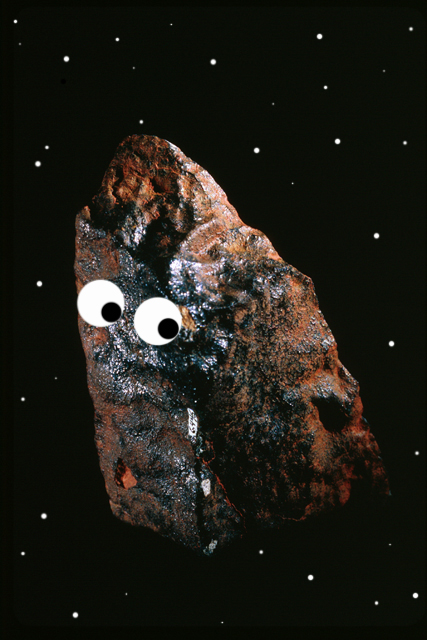
Okay, the last one wasn't wrong, but I just had a mental image of a lurking meteor(ite), and it looked something like this:


Watch out, folks. Those space rocks will get you.

Friday, October 29, 2010

Geological Frightfest: El Monstruo de los Volcanes

Tonight's post will be a short one, because it's Friday and I just spent the last hour carving a pumpkin. This Frightfest offering comes via the suggestion of a devoted reader (thanks, Mom!), and I had to post it, even though I can't find out a lot about the movie. This is the best I could dig up for El Monstruo de los Volcanes: A yeti-like creature with the power to hypnotize its victims stalks the slopes of Mount Popocatepetl, attacking construction workers who are building an inclined railway on the volcano.

Yep, a 1962 horror movie about a volcano yeti. I don't think I can add much to that. (Here's a Spanish website with a short blurb about the movie, for those of you who can read it. Oh, and funicular is another word for an inclined railway, if you get stuck translating it.)

On the volcanic side of things, Volcan Popocatepetl (the name means "smoking mountain" in the Aztec language) is a large stratovolcano about 70 km SE of Mexico City. Its most recent  eruption began in January 2005 with a series of phreatic explosions, and has continued since with explosive eruptions of ash and the extrusion of a lava dome. (Check out the GVP's monthly and weekly summaries for more details!)

Wednesday, October 27, 2010

Geological Frightfest: The Mole People

http://upload.wikimedia.org/wikipedia/en/8/8e/Mole_People.jpg
I thought I'd go with a classic film for today's edition of Geological Frightfest, because the premise of The Mole People is just so interesting. It's not actually one I've seen, and I know a lot of younger readers probably won't have ventured into the realm of 1950s horror, so here's a bit of summary from Wikipedia:

"The film begins with a narration by Dr. Frank Baxter, an English professor at the University of Southern California, explaining the premise of the movie and its basis in reality. He briefly discusses the hollow earth theories of John Symmes and Cyrus Teed among others, and says that the movie is a fictionalized representation of this unorthodox point-of-view.

"In this movie, archaeologists Dr. Roger Bentley and Dr. Jud Bellamin stumble upon a race of Sumerian albinos living deep under the Earth. They keep mutant humanoid mole men as their slaves to harvest mushrooms, their primary food source, since they can grow without sunlight. The Sumerian albinos' ancestors moved into the subterranean after the cataclysmic floods in ancient Mesopotamia."

The mention of the "Hollow Earth" idea was what caught my eye. In college, I took a freshman seminar called "Applied Pseudoscience", where we discussed logical fallacies and pseudoscience topics like this theory; our textbook was the venerable Fads and Fallacies in the Name of Science by Martin Gardner (1952), and that's where I turn whenever hollow Earth ideas get mentioned. Captain John Cleves Symmes first came up with the idea of a hollow Earth in 1818, when he suggested that the Earth was made up of five concentric spheres, both sides of which sustained plant and animal life, with huge openings at the poles. (He campaigned for years trying to get the U.S. Congress to fund an expedition to the North Pole, without success, and died in 1829 from the strain of constant campaigning.) Cyrus Reed Teed, another 19th century American, tried to advance an even more bizarre idea - that we were living on the inside of a hollow sphere, with the sun, moon, planets and stars inside the hollow and nothingness outside. (According to this idea, the internal sun is half light and half dark and rotates, thus producing day and night. If you think the sun is a light bulb, that sort of makes sense; it's when he starts talking about planets as "spheres of substance aggregated through the impact of afferent and efferent fluxions of essence" that I get lost.)

The idea had been mentioned even earlier than the 19th century, however. Edmund Halley published an essay in 1692 describing an Earth with a shell 500 miles thick, two inner shells the size of Mars and Venus, and a solid inner sphere the size of Mercury (all of which should be capable of bearing life). A particularly brilliant display of the aurora in 1716 prompted him to suggest that the lights were caused by glowing gas escaping from thin spots in the outer sphere at the poles. Doubtless there were many people before Halley who came up with similar ideas, perhaps related to the idea of an underworld - although they probably never came up with something as odd as mushroom-harvesting mutant mole men!

PS - It looks like you can read a pretty good chunk of Fads and Fallacies via Google Books, and I highly recommend it; it's a pretty funny book and covers a lot of pseudoscientific topics, although it can get a bit dense in parts.

Tuesday, October 26, 2010

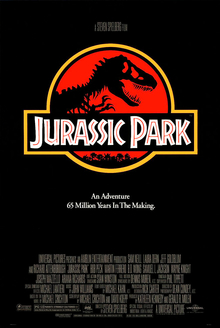
Geological Frightfest: Jurassic Park

http://upload.wikimedia.org/wikipedia/en/e/e7/Jurassic_Park_poster.jpg
Okay, given the super-gory, blood-soaked grossness that today's monster movies seem to be embracing, Jurassic Park is pretty tame. Tasteful, even, when people get eaten by dinosaurs. But let me tell you, when it came out in 1993, that was a pretty darn scary movie. (I remember seeing it as an eight-year-old, and I can't remember a movie since that's actually frightened me out of my seat and two or three feet vertically above it.) I'd been on the Dinosaur ride at Disney World, and these were certainly far beyond the jerky, obviously mechanical critters on display there. 

But aside from freaking out an eight-year-old who then dragged her parents to the National Museum of Natural History's Dinosaur Hall a whole lot more often, Jurassic Park opened up a whole can of exciting - and frightening! - possibilities about paleontology to the general public. Were dinosaurs really that vicious? What if we could recreate them using DNA recovered from fossils? Were paleontologists already trying to do that? And if it was possible, could we control our creations - before they decided to eat us, that is? (Frankly, I always thought that they could have solved that problem by not creating carnivores in the first place, but that would have made for a much less exciting plot. Nobody wants to see a movie where the main danger from the monster is accidentally getting stepped on.)

There was a lot of discussion of the question of recovering viable, ancient DNA (although not necessarily from amber) in the 90s, but it seems pretty clear that even if there was DNA preserved, it wasn't likely to be complete and undamaged. Even the 'mummified' hadrosaur discovered in 2007, which was extremely well-preserved, didn't net anyone a full genome. (For a discussion of why it would be tough to make a dinosaur even if we did have all the DNA we needed, have a look at the University of California Museum of Paleontology's Dinobuzz page - it's lacking some references, but I suspect it's not meant to read like a journal article.)

But questions of ability aside, which dinosaur would we make if we actually could - and what would we do with it? Assuming that we could adjust its immune system to deal with today's diseases and find it something to eat, there's no telling how it would react to its environment or its creators. (If we made an herbivore, which tended to be large, would it just act like a big cow? Would a carnivore try to eat people, or would it be happy with goat?) Like the scene in The Lost World where the t. rex gets loose in San Diego, a recreated dinosaur could cause considerable problems were it to escape from its handlers. (Sir Arthur Conan Doyle thought of this long before Michael Crichton ever did, by the way - although a pterosaur is a flying reptile and not a dinosaur.) And what about the dinosaur? Assuming that we were somehow able to allow it to grow up free of human influences, wouldn't it be pretty scary for the dinosaur to have to deal with a modern world?

I think the scientific, ethical, and societal tangles that could be involved in recreating a dinosaur are plenty frightening - before you even get to the toothy, clawed, wants-to-eat-you part. (And no, I was not traumatized by seeing Jurassic Park when I was eight - if anything, it helped get me to the point where I could blog about it!)

Monday, October 25, 2010

Geological Frightfest: Tremors

Halloween is pretty much my favorite holiday - when else can I show up at school in costume? - and I've decided to resurrect the theme of geology in the movies for a Halloween series this week. To start us off, I'll turn to that classic geologic monster movie: Tremors.

http://en.wikipedia.org/wiki/File:Tremorsposter.jpg
Tremors often comes up when lists of geology-themed movies are mentioned. Not only does it feature hungry subterranean critters, and a visiting seismologist, but at one point the heroes of the film are actually protected from the monsters by rocks. (Apparently tunneling through unconsolidated sediments is pretty easy, but granite boulders present a bit of a problem if you don't have drill bits for teeth.) There's also an appearance by Reba McEntire, for you music fans. 

The movie is supposedly set in the Nevada desert, but a little research shows that it was actually filmed in Lone Pine and Olancha, California, in Owens Valley just west of Death Valley National Park. The California State Geologic Map indicates that the area is mainly Mesozoic metavolcanic and plutonic rocks, with Quaternary sediments making up the valley fill. In case that wasn't exciting enough, the Owens Valley Fault Zone cuts right through the area. (Garry Hayes of Geotripper has featured Owens Valley in a number of great posts - including one about some real tremors in the area!)

One thing that always bothered me about this movie was the "graboid" wormy things and how fast they were able to burrow through the ground. They don't appear to have any means of locomotion other than wriggling and grabbing things with their mouths, but they somehow manage to chase down some very panicked humans. (According to this "Graboid 101" website, they have skin covered with "movement hooks" that help pull them through the ground and that their large jaws enable them to "dig through the land at high speed", but I'm not buying it.) At a top speed of 15-20 mph (estimated here), these critters would far outstrip the top speed of an earthworm of the same scale. (To do some rough, totally gratuitous math: This paper estimates that a vigorous earthworm has a top speed of 10 mm/s, or 0.022 mph; assuming that a reasonable earthworm length is ~ 3 inches, scaling up to a 30-foot earthworm would still only get you a top speed of ~2.5 mph. Not even fast enough to catch a walking human!) Not to mention that this wouldn't even account for variations in the consolidation of sediments or soil, having to detour around the odd buried boulder, etc.


So while this classic movie spawned three sequals and a 2003 TV series, you shouldn't be worried about tremors of the graboid variety while visiting the Owens Valley - but watch out for earthquakes!

Tuesday, May 5, 2009

If I were a geologist on Star Trek...

...I could apply for a joint medical degree, because sometimes rocks need doctoring.


...Sometimes a rock hammer wouldn't be enough to deal with those really stubborn minerals.


...I could give up hand lenses, thin sections, petrographic microscopes, microprobes, XRD, and point counting for this...

(although a good geologist would never give up their hand lens)

...It wouldn't take me until the end of the episode to figure out that I could use the local geologic resources to make a cannon to fire at the angry dinosaur-type aliens.


...I'd be really popular whenever Scotty needed some new dilithium crystals.


Unfortunately, I'm not a geologist on Star Trek (they tend to be rather expendable, at any rate). But I will be a geologist watching Star Trek when the movie comes out on Friday!

(Sorry for the sparse posting - grading and finishing up the final version of my thesis proposal is eating up all my time! Something more substantial later this week, I promise.)

Friday, January 9, 2009

Geology and the movies again...or "Why Disney's Pocahontas Briefly Makes Me Want To Scream At The TV"

This is actually an older post I've been sitting on, but I wanted to get something posted this week, even if it's not about current events.

I love watching Disney movies, but occasionally the scientist gets in the way of the nostalgic enjoyment. I was reminded of this when "The Virginia Company" came up on my music player's shuffle list. Pocahontas, which came out in 1995, is set in an area that I'm now very familiar with (the Historic Triangle, home of Yorktown, Williamsburg and Jamestown). It's also on the Coastal Plain, which William & Mary's Geology Department is very favorably situated to study. In fact, unless you drive west for an hour or so, all you see in that part of Virginia is Coastal Plain. Aside from the cool fossils and some of the sedimentary features (and a big honking impact crater, although you can't see it) the Coastal Plain has relatively little to interest a volcano nut - I had to go out to Richmond to see any hard rock aside from river cobbles.

From the Geology of Virginia Website at W&M (click to view the bigger version).

That doesn't mean I didn't pay attention to the Coastal Plain geology. I did - and that's why seeing the beautiful landscapes that show up during John Smith's bold adventuresomeness in the "Mine, Mine, Mine" sequence irritates me enough that I want to smack the animators.


Where the hell did that mountain come from? (For that matter, why is it magically spouting a waterfall?) Did any of those animators actually go to Jamestown? Or look at a photo? Or a map? Jamestown is pretty much in a swamp, which was a really poor choice to begin with (one might assume that the colonists weren't thinking about the scenic needs of future moviemakers when they landed there). There are no mountains, no waterfalls, and NO CLIFFS there...

...unless you count the crumbly sandy ones along the rivers.

See? Not impressive*. What is impressive is that John Smith apparently had the ability to teleport himself to the Piedmont in the course of the musical number, because you ain't getting those rolling hills in Eastern Virginia. And the scene where Pocahontas jumps over a waterfall from a tall rocky cliff means that she managed to teleport all the way out to the Blue Ridge, because you don't get waterfalls without bedrock, and the Coastal Plain doesn't have it.

The one thing that the movie does get right about the geology is that you'd have a hard time finding any gold on the Coastal Plain. In other parts of Virginia, certainly, but on the Coastal Plain, you sometimes have trouble just finding dirt, much less gold. (There is a LOT of sand out there, however.)

I'll ignore all the film's other inconsistencies here - screwing up all the Native American names, and the whole John Smith/Pocahontas thing, which didn't really happen - since other people have ripped into them much more eloquently than I could. Let's just say that while the Disney crew might have had good intentions, they managed to both insult Virginia's current Native Americans and perpetuated a beloved but totally inaccurate American myth. AND annoy the geologists.

I'm not saying that the more historically accurate movies are much better, mind you. The New World, which actually was filmed near Jamestown (the movie people hung out in Williamsburg when they weren't filming, which the W&M crowd thought was pretty cool), is a mind-numbing artsy-fartsy epic that drags on until you find yourself wanting to join the colonists who are croaking from malnutrition. It does get the utter stupidity of trying to found a colony on swampland that the natives obviously aren't even bothering with, as well as the oppressive heat and humidity and clouds of biting insects right, but in this case accuracy doesn't make for entertaining cinema. (And those actors really were out in an Eastern Virginia summer, which makes me feel really sorry for the ones who had to wear wool. I spent one summer in Williamsburg and immediately vowed never to do so again, because I like to breathe air rather than soup.)

In the end, I do realize that Pocahontas is a cartoon, and Disney, and geologic accuracy was not a major concern of the movie. But I do feel like the animators cut some corners and went for flashy rather than putting in the effort to reproduce what the Jamestown colonists might really have seen when they arrived in what would eventually become Virginia. For a movie that was otherwise beautifully animated, that was a real disappointment.

And I cannot forgive the cliffs. :)

*In fact, we reduced what little impressiveness they have by initiating multiple mass wasting events just by digging.

Thursday, May 22, 2008

Hat? Check. Leather Jacket? Check. Whip? Hm...

Nah, don't actually have the whip. But I do have the hat and the jacket and a minor in anthropology.

It's about darn time.

Thursday, May 15, 2008

Because Earth science does way more than rock

Here's a good resource for anyone who's introducing students to Earth science, trying to keep it in or add it to a curriculum, or anyone who wants to see really cool animations. It's AGI's "Why Earth Science" video, which they've recently posted on the web.


There's also an accompanying brochure available for downloading in English and Spanish versions.

Monday, March 24, 2008

Accretionary Wedge #7: Geology/ists in the Movies

Welcome to the 7th edition of the Accretionary Wedge – and happy birthday to John Wesley Powell, one of geology’s first real action heroes! This month's scrapings dealt with (depending on how you look at it) one of the biggest sources of headaches or entertainment for the denizens of the Geoblogosphere: Geology/ists in the movies.

Or, as some of the commentary seems to lean toward, "How Hollywood manages to screw up, in movie and/or TV form, the science that it took me multiple years, pints of blood and continuing therapy sessions to learn, and why I can't be held legally responsible for my reaction when the students in my intro classes spout it back at me on exams."


Just kidding – but only a little. Geology in the movies seems to bring out both the passionate and the flippant in us. We mark geology movies as points of inspiration in our journey toward our chosen profession; we happily do our best MST3K impressions while tearing apart the shoddy science; we laugh at the absurdities and turn even the worst transgressions into teaching opportunities. Seeing your science represented in film can be both maddening and gratifying, and as a result this month’s posts cover the full spectrum of praise and pugnacity.


I’ll be a little self-indulgent and mention my favorite geology movie (the video of which I’m currently ignoring in favor of writing this), the 1959 version of Journey to the Center of the Earth. I’m fond of all of the characters, even James Mason’s bellowing Professor Lindenbrook, but in my opinion, the real hero – and possibly the best geologist – in the movie is…Gertrude the duck. After all, it is Gertrude who discovers the proper entrance into the bowels of Mount Sneffels, Gertrude who enforces mine safety practices by removing stealing Madam Goteborg’s stays (which could have impeded her breathing), and Gertrude who, by being eaten by Count Sakneussem, leads the group to the Lost City of Atlantis and their volcanic escape route. (Okay, that was a stretch.) And Gertrude aside, Journey is just good campy fun. Giant mushrooms, dimetrodons, phosphorescent pools, lost cities, and singing geologists may be cheesy, but sometimes cheesiness is enjoyable for its own sake.

Had enough previews? Then it’s time for our feature presentation:


Just because you have a deep spiritual connection with volcanoes doesn’t mean you can predict eruptions, according to Chris Rowan of Highly Allocthonous. Hunches are often a good place to start, but unless you back up your gut feeling with a little science, people probably aren’t going to take you seriously. Not even if you’re Pierce Brosnan.

Chris at goodSchist takes us on a tour of the extreme geology to be found on the planet Crematoria in The Chronicles of Riddick. With a name like Crematoria and planet-wide explosive volcanic eruptions ever three hours, this place certainly isn’t going to beat out Cancun as a prime spring break destination – unless you’re a geologist, that is.

MJC Rocks at Geotripper gives us a who’s who of geologists in the movies, bringing together victims of volcanic eruptions, velociraptors, alcoholism, avalanches, and even a few who survive with only minor injuries. (Has Hollywood got a grudge against us or something?) There’s even a reminder that one of the most beloved fictional anthropologists, Indiana Jones, had his roots in a real-life extreme paleontologist.

Here’s something to look forward to – Journey to the Center of the Earth has been remade yet again! In 3D! With giant albino dinosaurs! And Brendan Fraser riding around in a mining cart! What could be better? Mel at Ripples in Sand hopes that the educational campaign accompanying the movie will be slightly more accurate than all that. (She also mentions The Great Warming, which seems to have slipped under the collective radar; I’ll put out a milk carton alert and ask, Have You Seen This Film?)

Some of us are lucky enough to be able to turn snarking into credit hours! John Van Hoesen has a class called “Geology in Film”, and brings to our attention some real classics of geo-cinema. Who knew Paul Newman did disaster flicks?

Not content to stop at a single entry, Dr. Mike at Otago has created an entire blog devoted to “Reel Geology”. Not to be missed is the entry for “Best Use of Mineralogy in a Movie,” awarded to The Monolith Monsters, which apparently features “a water-activated silica-sucking meteorite and ends with the hero saving the town by blowing up a dam conveniently located upstream of a salt mine.” ‘Nuff said.

Steve McQueen as a climate change prophet? Believe it. Callan Bentley at NOVAGeoblog gives us a lovely little tidbit from The Blob that suggests another excellent reason to step up our efforts to slow global warming…

Did you ever wish you could set the filmmakers straight? Well, Jim Repka at Active Margin might have done just that – however briefly. His close encounter with The Core may not have resulted in real science making it into the movie, but at least one anonymous writer now knows the meaning of gigapascal. (He also notes that nuclear weapons may be the next great innovation in seismology. Hmm...)

As a self-admitted Trekkie/Trekker, I was very happy to see the post by Silver Fox at Looking for Detachment about The Devil In The Dark, a Star Trek: TOS episode in which Kirk, McCoy and Spock encounter the galaxy’s first silica-based life form. Being able to mind-meld with a rock would be a fabulous asset for a geologist. Being a geologist on Star Trek, however, would not be so fabulous, as they tend to be relegated to the ranks of the Redshirts. (For those who aren't familiar with the Original Series, Redshirt = cannon fodder. Sometimes they even manage to kill them before the episode starts.)

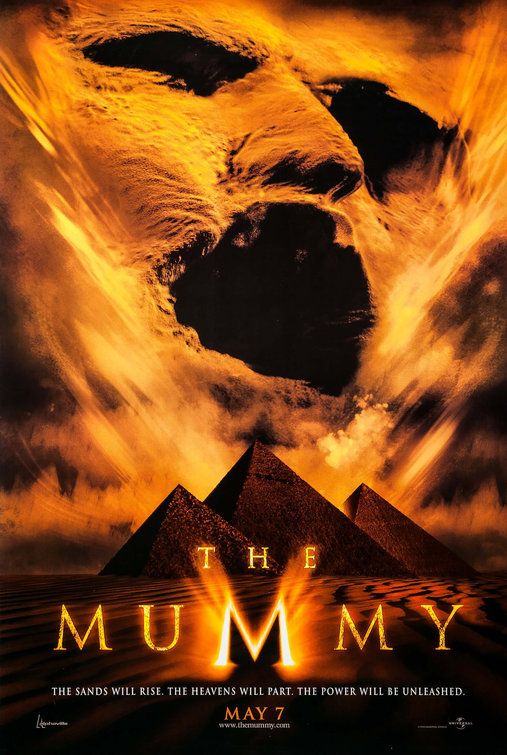
Run for your lives – sedimentology is out to get you! Well, not really – but it is out to get Peter Parker in the next Spiderman movie, in the form of the villain Sandman. Thanks to BrianR at Clastic Detritus for the heads-up…and hopefully Imhotep from The Mummy won’t be too jealous.

Laelaps’ multimedia post brings us once again to the exciting world of extreme paleontology, where he explores the declining standards of the Jurassic Park movies; Professor Challenger, the first paleontological action hero in various incarnations of Conan Doyle’s The Lost World; and the likelihood that Cary Grant probably wouldn’t survive a real field camp, despite being Cary Grant. (Frankly, for high odds of survival in a dinosaur-ridden feature, I’d stick with Sam Neill, although he lost a lot of cred with that velociraptor duck-call in the third movie.)

Argus Panoptes at Astronomical Seeing points out why Ross of Friends makes a worse paleontologist than Cary Grant. (He is, indeed, way too well-groomed and lacking proper paleontological attire. One suspects that his field experience is mostly limited to obtaining beer in a crowded bar during a Yankees game, and not obtaining beer while camped in the middle of the Montana desert and trying to hide a secret scotch supply from a pack of ravenous graduate students.)

It's probably the one and only time a movie featuring a geologist has won any Oscars, let alone multiple ones. There Will Be Blood, featured in ZS's post at Hindered Settling, takes a look at the oil industry in the early twentieth century. It also explores the less charming side of geologists, and leads us to suspect that the main character may have forgotten his coffee supply, since he at one point looks for oil in a silver mine.

Last, but certainly not least, we have doomsayer Julian from Harmonic Tremors, who warns us that the big one is coming, and there’s nothing we can do about it. Fortunately, it’s not a monster earthquake but a movie about one – an incarnation of the novel 1906 by James Dalessandro, set during the San Francisco earthquake. Though it has its faults (I had to steal that one), including, refreshingly enough, too much science, Julian advises us to put our trust in Brad Bird and Pixar. (And yes, it would be really fun if a bunch of us geobloggers went to see it together – I’m game if you all are!)


Thank you all for your contributions – and for putting up with my own snarking, which has probably grown increasingly less witty and more random, since it’s getting pretty late where I am. Next up among the Accretionary Wedge volunteers is Andrew over at About.com Geology, who’s going to be hosting an Earth Day carnival – don’t forget to check the “Who’s hosting the next Accretionary Wedge” page for updates.

That’s all, folks!

PS - Apologies if I missed anything that was posted before the deadline; let me know and I'll add it on!

Friday, March 21, 2008

An appropriate situation for "ROTFL"

Okay, I don't usually talk about the whole evolution/creationism thing, but this post on Pharyngula is just about the funniest thing I've seen all week. I had to share.

Monday, March 17, 2008

Just a reminder: Accretionary Wedge #7 is coming up!

The deadline for submitting posts for the next Accretionary Wedge is Sunday, March 23 (just in time to overdose on Easter chocolate and let loose the ranting)!

The subject is Geology/ists in the Movies. What do you love, loathe, laugh at and ridicule about Earth science and scientists as Hollywood envisions them? Here's your chance to drag up the most obscure films you can find, or revive discussions of recent ones, and extol their virtues or castigate their failings as you wish. Ranting and raving encouraged!

Please have everything emailed, linked or commented on by 6PM Eastern Standard Time. I'll post up on Monday so you can all indulge in some post-Lenten-season movie-whomping!

Monday, February 25, 2008

Accretionary Wedge Call for Posts: Geology/ists in the Movies

Installment #6 of The Accretionary Wedge is up at Lounge of the Lab Lemming, and there are more submissions than ever, all of them definitely hmmm-provoking. I didn't get a post in this time, but I did volunteer to host the next one, so here it is:

Geology/ists in the Movies

This should be pretty easy - there's no end of movies out there (many made by the SciFi channel, for instance) that attempt, successfully or not, to depict geoscience and geoscientists. Which one is your favorite? Your least favorite? What do you hate or love about it? What does Hollywood do that drives you crazy? What's the dumbest mistake you've seen them make?

I can guess the obvious culprits, but this is a chance for all you film buffs out there to show off your knowledge of cinema history and pull out some older offenders for our castigation pleasure. TV movies and series are also game, since the SciFi channel (at least) seems to be really determined to give us such prime material for ranting. (And to allow for a wide range of submissions, space movies are fair game as long as there's some sort of rock science involved.)

I'm setting the final submission date as Easter Sunday (March 23rd); entries should be in by 6 PM Eastern Standard Time to be included. Post a link to your entry in the comments section, or email them to me using the address in my profile. I'll post it all up on Monday the 24th, in honor of John Wesley Powell's birthday. (He could even be considered the first geology action hero; after all, a crusty one-armed Civil War veteran rafting into uncharted lands on the Colorado is pretty adventurous.)

Let the ranting begin!