Saturday, October 30, 2010

Geological Frightfest: The Monolith Monsters


Lee Allison at Arizona Geology deserves credit for inspiring the last movie in the Frightfest series - in his post from June about the Piranha 3D movie, he also mentioned The Monolith Monsters. Again, it's another 1950s movie I haven't had the chance to see, but I'll definitely have to remedy that if I can...guess what's next on the Netflix queue? With a title like that, though, I couldn't resist looking it up. And boy, this one is a doozy. Here's the IMDB summary:
A strange black meteor crashes near the town of San Angelo and litters the countryside with fragments. When a storm exposes these fragments to water, they grow into skyscraper-sized monoliths which then topple and shatter into thousands of pieces that grow into monoliths themselves and repeat the process. Any humans in the way are crushed or turned into human statues. The citizens of San Angelo desperately try to save themselves and the world from the spreading doom.
Wikipedia also expands on this with some dirt on some of the main characters, who happen to be geologists (though apparently not very good at on-the-fly rock identification):
In the desert region of San Angelo, California, geologist Ben Gilbert brings a strange black rock back to his office, where he and bored local reporter Martin Cochrane examine it but fail to determine its origin. That night, a strong wind blows a bottle of water over onto the rock, which begins to bubble and smolder. The next day, the head of the geological office, Dave Miller, returns to town from a business trip and finds the office destroyed by a huge growth of black rock and Ben dead, in a rock-hard, apparently petrified state.
Things certainly go downhill from there. The rocks spread via the pockets of students on a geology field trip, and pretty soon folks are turning into stone left and right. Not only are the rocks sucking silica out of people, but coming into contact with water allows them to grow and multiply. (Since humans only contain trace amounts of silica, these are obviously not very smart rocks.) The geologists eventually figure out that these are evil outer space rocks, and that salt water (???) will stop their growth. I won't tell you the thrilling conclusion, although it's there in the Wikipedia summary (spoiler alert!) if you want to read it.

This movie is impressive not only for the fact that it has evil space rocks sucking the silica out of people, but for its fantastically corny (and geologically incorrect) dialog. Here are a few gems:
"The desert's full of things that don't belong. Take the salt here. Used to be an ocean bed. Now that ocean knew that the middle of a desert was a pretty silly place for it to be, so it just dried up and went away."

"You've got to remember, Dave, when this hit our atmosphere, it burned at such a fantastic temperature, that its metal-bearing compounds could have been altered - left ready to activate, to grow!"

"From infinity they come. Meteors! Another strange calling card from the limitless regions of space - its substance unknown, its secrets unexplored. The meteor lies dormant in the night - waiting!"
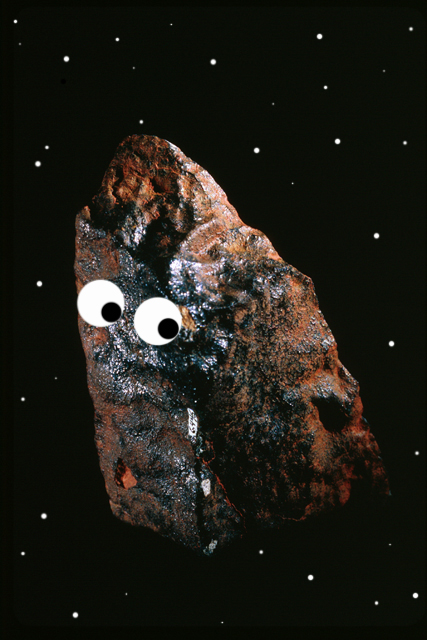
Okay, the last one wasn't wrong, but I just had a mental image of a lurking meteor(ite), and it looked something like this:


Watch out, folks. Those space rocks will get you.

Friday, October 29, 2010

Geological Frightfest: El Monstruo de los Volcanes

Tonight's post will be a short one, because it's Friday and I just spent the last hour carving a pumpkin. This Frightfest offering comes via the suggestion of a devoted reader (thanks, Mom!), and I had to post it, even though I can't find out a lot about the movie. This is the best I could dig up for El Monstruo de los Volcanes: A yeti-like creature with the power to hypnotize its victims stalks the slopes of Mount Popocatepetl, attacking construction workers who are building an inclined railway on the volcano.

Yep, a 1962 horror movie about a volcano yeti. I don't think I can add much to that. (Here's a Spanish website with a short blurb about the movie, for those of you who can read it. Oh, and funicular is another word for an inclined railway, if you get stuck translating it.)

On the volcanic side of things, Volcan Popocatepetl (the name means "smoking mountain" in the Aztec language) is a large stratovolcano about 70 km SE of Mexico City. Its most recent  eruption began in January 2005 with a series of phreatic explosions, and has continued since with explosive eruptions of ash and the extrusion of a lava dome. (Check out the GVP's monthly and weekly summaries for more details!)

Thursday, October 28, 2010

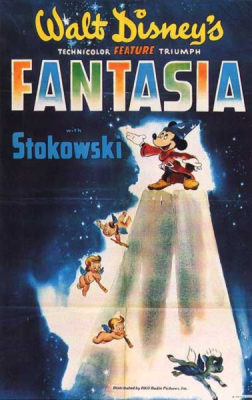
Geological Frightfest: Fantasia

http://en.wikipedia.org/wiki/File:Fantasia-poster-1940.jpg
All right, so Fantasia probably isn't the first thing you think of when the topics of horror movies or geology come up (and I'm not talking about the whole movie, so I'm cheating a bit with this one). But I am talking about the excellent Night on Bald Mountain sequence, where the animators set Modest Mussorgsky's composition of the same name.

I loved Fantasia as a child, and still do - but I have to admit that this sequence was pretty darn scary. (Disney did include it years later in their Halloween Treat TV special, after all - remember that? I used to watch it every year.) Anyway, a quick summary of the animation: In the dead of night, the huge, craggy mountain looming over a small European town becomes the haunt of a huge winged demon and the gathering place of ghosts, ghouls, devils, witches, and all manner of fell creatures. They proceed to have a fiery revel, but are forced back to their lairs by the tolling of church bells.

While the animation is truly imaginative, it's the music that brings me to a geological reference - and the setting that inspired Mussorgsky's title. (Or, rather, Rimsky Korsakov's orchestral arrangement of Mussorgsky's original tone poem St. John's Night on the Bare Mountain.) A bald or bare mountain, in East Slavic (and especially Ukranian) mythology, is a place where witches and other evil creatures gather for their Sabbath. In Ukranian, the term is lysa hora, which is also the name given to many "bald" mountains in Ukraine and Poland. One of the most famous is the Lysa Hora in Kiev, which was supposedly the site of some of the largest witches' gatherings.

This got me to wondering: Why would these hills be bare in the first place? Perhaps there's some geology at work here. In the Blue Ridge mountains, for example, there are a number of spots where the mountaintops are rocky and relatively bare of trees; Old Rag Mountain is topped with granite, and Blackrock Summit with well-cemented quartz sandstone. I was able to find this map of the geology of the USSR (from 1944), but I can't read or type Cyrillic, so it's not much help. Ole Nielsen has a post on kimberlites in the Ukranian Shield which mentions granites, an excellent candidate rock type for bare-topped hills, and possibly what one might find on the summit of a lysa hora. Why would these rocks form bare summits? Well, granite can take an extremely long time to form enough soil to support plant life, especially if it's exposed to transport processes by being at the top of a mountain - and while a sandstone might weather more easily, it needs some organic inputs before it will form anything but...well, sand.

So, it's a good bet that the impressive winged demon in the Fantasia sequence is clinging to something granitic, although the craggy peak in the film is showing just a teensy bit of vertical exaggeration, if you ask me.

The move has finally happened!


Magma Cum Laude has officially moved to its new home at the AGU Blogosphere, http://blogs.agu.org/magmacumlaude/ - you know, that thing that a bunch of us have been hinting at for a while now. But don't fret; I'll be cross-posting on this site for a little while in case you forget to update your bookmarks and RSS feeds. (By the way, update your bookmarks and RSS feeds!) All the old posts from this site will be archived at the new blog as well.

It's been a long time coming, but I'm happy to be making the move to a different blogging platform, and thrilled to be enjoying the company of such excellent geobloggers. (Go to http://blogs.agu.org to see the full lineup!)

Spooky Deskcrop - Accretionary Wedge #28

The latest Accretionary Wedge is being hosted at Research at a Snail's Pace by Matt Kuchta...and the theme is deskcrops (spooky if possible, for Halloween!) My favorite deskcrop is one that I acquired fairly recently on Montserrat, from the February 2010 dome collapse deposits of the Soufriere Hills volcano. This isn't a particularly small sample, but it was one of the easiest to collect - already pre-rounded, and of course it didn't add much mass to my luggage, because it's a chunk of pumice! (Sorry for the color variations in the next few photos - I was using the cheap camera and the color balance always goes wonky on that one.)


What I find really spooky about this particular sample is that it has a story to tell, recorded in that big black mark. It's suspiciously femur-shaped. 

Femur figure courtesy of Gray's Anatomy, via Wikimedia Commons.
But don't worry! That mark has nothing to do with human remains (no one was killed in that dome collapse, and I would never disturb remains if I came across them). It's actually a scorch mark from a tree limb that I found the pumice block resting against. Remember this photo?


When this pumice flow lobe came into contact with the vegetation in this area, it was hot enough to scorch it, and in a lot of cases the pumice clasts are still resting on the tree limbs they burned. This particular piece of pumice records the shape of one of those limbs.The scorch mark itself is pretty cool - it's sooty from the carbonized wood, but it also has little patches of remelted glass. 


And, for all you mineralogists out there, here's a really nifty little shattered hornblende phenocryst. (The predominant composition of the eruptive products at Soufriere Hills is andesitic, so there are also quite a few large plagioclase phenocrysts in there as well.)


Scorching!

Wednesday, October 27, 2010

Geological Frightfest: The Mole People

http://upload.wikimedia.org/wikipedia/en/8/8e/Mole_People.jpg
I thought I'd go with a classic film for today's edition of Geological Frightfest, because the premise of The Mole People is just so interesting. It's not actually one I've seen, and I know a lot of younger readers probably won't have ventured into the realm of 1950s horror, so here's a bit of summary from Wikipedia:

"The film begins with a narration by Dr. Frank Baxter, an English professor at the University of Southern California, explaining the premise of the movie and its basis in reality. He briefly discusses the hollow earth theories of John Symmes and Cyrus Teed among others, and says that the movie is a fictionalized representation of this unorthodox point-of-view.

"In this movie, archaeologists Dr. Roger Bentley and Dr. Jud Bellamin stumble upon a race of Sumerian albinos living deep under the Earth. They keep mutant humanoid mole men as their slaves to harvest mushrooms, their primary food source, since they can grow without sunlight. The Sumerian albinos' ancestors moved into the subterranean after the cataclysmic floods in ancient Mesopotamia."

The mention of the "Hollow Earth" idea was what caught my eye. In college, I took a freshman seminar called "Applied Pseudoscience", where we discussed logical fallacies and pseudoscience topics like this theory; our textbook was the venerable Fads and Fallacies in the Name of Science by Martin Gardner (1952), and that's where I turn whenever hollow Earth ideas get mentioned. Captain John Cleves Symmes first came up with the idea of a hollow Earth in 1818, when he suggested that the Earth was made up of five concentric spheres, both sides of which sustained plant and animal life, with huge openings at the poles. (He campaigned for years trying to get the U.S. Congress to fund an expedition to the North Pole, without success, and died in 1829 from the strain of constant campaigning.) Cyrus Reed Teed, another 19th century American, tried to advance an even more bizarre idea - that we were living on the inside of a hollow sphere, with the sun, moon, planets and stars inside the hollow and nothingness outside. (According to this idea, the internal sun is half light and half dark and rotates, thus producing day and night. If you think the sun is a light bulb, that sort of makes sense; it's when he starts talking about planets as "spheres of substance aggregated through the impact of afferent and efferent fluxions of essence" that I get lost.)

The idea had been mentioned even earlier than the 19th century, however. Edmund Halley published an essay in 1692 describing an Earth with a shell 500 miles thick, two inner shells the size of Mars and Venus, and a solid inner sphere the size of Mercury (all of which should be capable of bearing life). A particularly brilliant display of the aurora in 1716 prompted him to suggest that the lights were caused by glowing gas escaping from thin spots in the outer sphere at the poles. Doubtless there were many people before Halley who came up with similar ideas, perhaps related to the idea of an underworld - although they probably never came up with something as odd as mushroom-harvesting mutant mole men!

PS - It looks like you can read a pretty good chunk of Fads and Fallacies via Google Books, and I highly recommend it; it's a pretty funny book and covers a lot of pseudoscientific topics, although it can get a bit dense in parts.

Tuesday, October 26, 2010

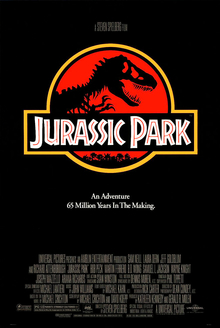
Geological Frightfest: Jurassic Park

http://upload.wikimedia.org/wikipedia/en/e/e7/Jurassic_Park_poster.jpg
Okay, given the super-gory, blood-soaked grossness that today's monster movies seem to be embracing, Jurassic Park is pretty tame. Tasteful, even, when people get eaten by dinosaurs. But let me tell you, when it came out in 1993, that was a pretty darn scary movie. (I remember seeing it as an eight-year-old, and I can't remember a movie since that's actually frightened me out of my seat and two or three feet vertically above it.) I'd been on the Dinosaur ride at Disney World, and these were certainly far beyond the jerky, obviously mechanical critters on display there. 

But aside from freaking out an eight-year-old who then dragged her parents to the National Museum of Natural History's Dinosaur Hall a whole lot more often, Jurassic Park opened up a whole can of exciting - and frightening! - possibilities about paleontology to the general public. Were dinosaurs really that vicious? What if we could recreate them using DNA recovered from fossils? Were paleontologists already trying to do that? And if it was possible, could we control our creations - before they decided to eat us, that is? (Frankly, I always thought that they could have solved that problem by not creating carnivores in the first place, but that would have made for a much less exciting plot. Nobody wants to see a movie where the main danger from the monster is accidentally getting stepped on.)

There was a lot of discussion of the question of recovering viable, ancient DNA (although not necessarily from amber) in the 90s, but it seems pretty clear that even if there was DNA preserved, it wasn't likely to be complete and undamaged. Even the 'mummified' hadrosaur discovered in 2007, which was extremely well-preserved, didn't net anyone a full genome. (For a discussion of why it would be tough to make a dinosaur even if we did have all the DNA we needed, have a look at the University of California Museum of Paleontology's Dinobuzz page - it's lacking some references, but I suspect it's not meant to read like a journal article.)

But questions of ability aside, which dinosaur would we make if we actually could - and what would we do with it? Assuming that we could adjust its immune system to deal with today's diseases and find it something to eat, there's no telling how it would react to its environment or its creators. (If we made an herbivore, which tended to be large, would it just act like a big cow? Would a carnivore try to eat people, or would it be happy with goat?) Like the scene in The Lost World where the t. rex gets loose in San Diego, a recreated dinosaur could cause considerable problems were it to escape from its handlers. (Sir Arthur Conan Doyle thought of this long before Michael Crichton ever did, by the way - although a pterosaur is a flying reptile and not a dinosaur.) And what about the dinosaur? Assuming that we were somehow able to allow it to grow up free of human influences, wouldn't it be pretty scary for the dinosaur to have to deal with a modern world?

I think the scientific, ethical, and societal tangles that could be involved in recreating a dinosaur are plenty frightening - before you even get to the toothy, clawed, wants-to-eat-you part. (And no, I was not traumatized by seeing Jurassic Park when I was eight - if anything, it helped get me to the point where I could blog about it!)